Georgia honors 19 Vietnam combat Marines

Standard

Viet Marines

This is part of a broader, overdue program to thank over 200,000 of Georgia’s Vietnam veterans for their service.  From the Columbus Ledger-Enquirer:

Georgia recognizes Vietnam vets who served in Marine Corps

  • 19 Marines from the Chattahoochee Valley were presented a State Certificate of Honor and lapel pin for service in Vietnam
  • The recognition is part of the state’s program to recognize 234,000 Georgia veterans who served in armed forces during Vietnam
  • Program started a year ago as part of the 50th anniversary of the war

Book Review: Breaking Creed breaks into a gallop

Standard

Breaking Creed, a suspense novel by Alex Kava, opens with a girl swallowing condoms filled with cocaine.  Amanda is a drug mule seduced by an abusive Latin American kingpin.  Ryder Creed, who was a Marine and is now a dog handler, detects Amanda at Hartsfield-Jackson International Airport in Atlanta with the help of Grace, a Jack Russell Terrier with a nose for mischief.

Rather than turning Amanda over to the authorities at Hartsfield or taking her the hospital, Creed drives her to his home—in Florida!  This was an extremely peculiar and implausible decision that distracted me for several chapters.  The shock of a grown man taking an underage girl across state lines alone gradually wore off as we learned that Creed operates a halfway house that can help Amanda.

The Creed storyline is intercut with scenes of Special Agent Maggie O’Dell, who is assigned with a homicide case of a “floater” pulled out of the Potomac.  The victim was killed and tortured while strapped to a mound of fire ants.  O’Dell travels to Alabama to investigate where the torture took place.  The investigation and the investigators themselves are targeted by an unknown assassin who uses lethal animals or insects to strike his victims.  It’s a chilling approach.

Creed helps out on the Alabama case, too.  Grace, his Jack Russell Terrier, isn’t just a drug dog or a rescue dog or cadaver dog, she’s an all-purpose crime-stopping dog.  Whenever Grace finds what Creed seeks, he rewards her with her favorite thing—a pink elephant chew toy.  I’m not sure how plausible it is that Grace has so many talents, but she is a fun dog character.  Grace isn’t just a prop or an object of affection in the book—she is a dog that actually affects the plot in several ways throughout the book.

The assassin’s methodology, dog scenes, and galloping pace of the plot make Breaking Creed a fun, quick read.

Less enjoyably, there are many coincidences and convenient turns of events that cause Creed and O’Dell to work together throughout the book.  Their separate investigations merge more than once.  The way Creed and O’Dell get excited to see each other but try to play it cool reminds me of romance novel tropes.  A lot of emotions are attributed to Creed and other male characters in an unconvincing way like romance novelists sometimes do.  There is definitely more action here than in a Nora Roberts book, but overall I would categorize Breaking Creed as a romantic suspense, not as a thriller or mystery as it has been classified by Goodreads and Amazon.

Another word of warning:  although the back cover book blurb makes it sound like the book is set in Atlanta, it isn’t.  Only a couple pages are.

Breaking Creed is the first of the “Creed” series by Alex Kava.

Book review: my verdict on The Verdict

Standard

In Nick Stone’s The Verdict, a law clerk in Britain must defend an old enemy on charges of murdering a blonde in his hotel suite.  The clerk, Terry, decides to defend the suspect, VJ, as best as he can despite being burned by him 20 years earlier.  The defense team’s investigation takes Terry on a wild ride through the streets of London, dodging bullets and working with a colorful and sleazy investigator.

This is a well told story that keeps you guessing.  Is VJ’s story true or did he kill the blonde?  The investigation points in one direction, but will trial go the same way?  What were the reasons for Terry and VJ’s falling out and will they reconcile?  When will Terry’s law firm fire him?  The answers are expertly woven together throughout the course of the book.

In addition to the suspense, there are two other compelling aspects of the book.  First, the trial itself is engrossing.  Although we are familiar with the details of the investigation by the time the trial begins, Stone writes the lawyers’ opening statements, questions to the witnesses, and closing arguments in a way that keeps surprising us.

Secondly, Terry’s character is very well developed.  The book is told from his point of view.  Terry is very frank and personal with the readers about his own failings and past.  We learn more about him through the novel than his wife knows about him.  Because of that, you will feel closer to him than you may feel toward most protagonists in contemporary thrillers.

On the downside, the book is long.  It took me three times longer to read this compared to other thrillers I’ve read lately.  There were a few implausible scenes in Part III of the novel that didn’t work for me.  The trial does not begin until three-quarters of the way through the novel, so calling this a “courtroom drama” is misleading.  There is also a confusing B-story that related to the main story but didn’t add much to it.

Overall, I thoroughly enjoyed the book and would recommend it Grisham fans, speed readers, and Anglophiles.

Local Marines display 100 years of history

Standard

Two Marine veterans are displaying their collection of historical military gear around schools in Henry, Spalding and other counties just south of the Atlanta area.  They will also come to your location if it’s not too far.  This seems like it would be a great opportunity for boy scout troops, ROTC programs, and history classes to take advantage of.

The two men assembled their collection from shops and flea markets.  I hope they accept donations–I’d rather give some of my old gear to them than leaving it on the curb!  The Henry Herald reports:

Veterans give military history lessons from personal collection

By Johnny Jackson

jjackson@henryherald.com

Mar 4, 2016

McDONOUGH — Students marveled at the walkie-talkie — a stamped steel, two-way radio shaped like an 80s cellphone receiver, but twice as large.

The device stood atop a table of artifacts dating back 100 years, pieces of a personal collection owned by McDonough residents Lamar Scott and Buddy Simpson. It was part of their exhibit displayed this week in the Navy JROTC wing of Eagle’s Landing High School.

Scott, 68, and Simpson, 78, are veteran Marines who served during the Vietnam War-era and want that history to be told and memorialized.

Over the past decade, they have collected hundreds of pieces to display in visits to area schools, churches and senior centers. The exhibit covers military engagements from World War I to the Vietnam War.

“I’ve been collecting for about 11 years,” said Scott. “I started off with just a little bit of a collection. I went from a few shelves in the bedroom to a 6-by-12-foot trailer. And now we have an 8-by-20-foot trailer.”

Scott has managed to collect most of his items through flea market sprees in the North Georgia area, while Simpson has built his collection buying from shops across the Southeast.

“We do it to teach students about history,” he said. “If you forget your past, you have no hope for the future. We’re preserving history through wartime collection.”

He and Simpson have loyal friendships in Russ Vermillion and Terry McClure who volunteer their time helping show the historic pieces.

Both wartime veterans have a vested interest in the military histories. Vermillion served in the U.S. Marine Corps from 1968 to 1970, and McClure served in the Army from 1972 to 1974.

Vermillion keeps the group lively during exhibits with intermittent jokes, breaking lulls of seriousness with jest.

On Thursday, a cloud of chatter filled the Navy JROTC wing of Eagles Landing High, where the men and a few JROTC cadets spent seven hours setting up cabinets, table displays and mannequins.

About 50 mannequins clad in antique uniforms dwarfed the men as they answered questions from students passing through.

“These mannequins represent men and women that died for our freedoms,” said Scott. “The best representation is Jesus Christ that died for all of us. But if I can get four or five of these kids on the right road, I’ve done my job.”

Simpson said he regularly receives donations from people who might otherwise toss the historic items in the trash…

Osteoporosis, not man, killed the mammoths?

Standard

A mammoth graveyard in southern Russia shows no sign of significant human activity according to a new documentary.  The documentary also reveals that 40 percent of woolly mammoth bones indicate osteoporosis.  While this doesn’t let early man off the hook in terms of hunting mammoth populations elsewhere, it shows it wasn’t a factor in this case.  The other interesting aspect of this news article from The Siberian Times what may have drawn mammoths to the site:  salt.

Paleothithic man ‘not the main cause of deaths at vast mammoth graveyard’

By Olga Gertcyk

22 February 2016

Experts say no sign of any human settlements close to ‘largest necropolis in Asia for the extinct beasts’.

While a few human implements have been found at Mammoth village, there is a striking lack of man’s presence at the probably most recent known large cemetery for the ancient giants, according to a new documentary from Tomsk State University.

The film appears to clear Paleothithic man of having much to do with the demise of the species here, although the creatures were clearly filleted for meat and hide, and their tusks were purloined some 10,000 to 14,000  years ago.

All the implements were not made of local stone, and in fact came from hundreds of kilometres away from the site in Novosibrisk region that may hold the key to why the the mammoths finally died out. They were less weapons than butchering tools, it is believed.

So man did not live close to a place where the ailing mammoths came to die, but visited to raid the enfeebled animals after they tramped here from huge distances.

Paleontologists want to massively extend excavations at the site, known as Volchya Griva at Mamontovoye – or Mammoth – village after a dig in 2015 resulted in the discovery of more than 600 bones and teeth.

Eminent Soviet archeologist Aleksei Okladnikov in 1969 noticed how at the site ‘bones were lying at the same level horizontally – and had no marks of any sort of catastrophic influence’.

The short documentary cites a number of leading experts noting the lack of human presence at the site. Academician Dr Vyacheslav Molodin, an archeologist, one of the first researchers at Volchya Griva, said: ‘Of course when I went there I was hoping to find some human dwelling. But, unfortunately, we didn’t find it.’

Dr Vasily Zenin, of the Institute of Archeology and Ethnography in Novosibirsk, said: ‘It was expected to find a Paleolitic dwelling there, perhaps, some religious constructions.’ However, ‘when we started digging, it became obvious that presence of humans was very limited. There were no conditions for a permanent settlement in Volchya Griva or around it.’

Equally, the half dozen mammoth remains found during research in summer 2015 all appeared to have died relatively young. The creature had a lifespan of 60 to 80 years, but of the six animals found here included two that died between one and 12 years old, one under a year old and two between 12 and 25 years. Two were older than 25.

Intriguingly, some 40% of the woolly mammoth bones found here show signs of bone diseases.

The Siberian Times has examined previously the theory of Dr Sergey Leshchinsky, head of the Laboratory of continental ecosystems of Mesozoic and Cenozoic of  Tomsk State University, that osteoporosis was a key factor in the demise of the animals, and that the reason they came to this site was because it was a ‘salt lick’ offering them the chance to rectify mineral deficiencies…

How to sell your military skills to a civilian employer

Standard

Job Search

The book Job Search by Lt. Col. (Ret.) David G. Henderson provides good tips on the transition from the military to civilian employment. In Chapter 1, Henderson encourages readers to think about–and actually write down–what skills they have, what job preferences they have, and what goals they have. It may sound hokey, but it is a useful exercise that will prompt you to learn something about yourself.

The subtitle, “Marketing Your Military Experience,” refers to translating your military skills to a civilian hiring manager. This includes how to describe your experience and strengths on resumes. The book also includes smaller, practical tips; for example, avoid using military acronyms and don’t wear military dress shoes in civilian interviews.

The book is also helpful as a general employment guide with thoughtful suggestions on how to search for jobs and how to improve your resume. Henderson’s guidance is relevant to anybody seeking a second career or making a mid-life jump from one field to a very different field, because that’s essentially what military retirees are doing.

I read the 5th edition which was published in 2009. Even though the Internet had already been around for a long time then, the descriptions of online job searches in this book are quite dated. There are good resources listed for job searching, career assistance, and veteran support services, but some of the resources seem dated as well. The appendices are a bit too long and redundant bordering on fluff, but those pages can be skipped or skimmed.

This book is written from the point of view of a personnel officer attempting to help a servicemember who is within six months from retirement. However, I think it would be useful to veterans even several years after they have separated or retired from the military. Spend a few bucks to make sure you’re putting your best foot forward during a career transition!

Elephant sanctuary in Brazil reviews toxic plant risks

Standard

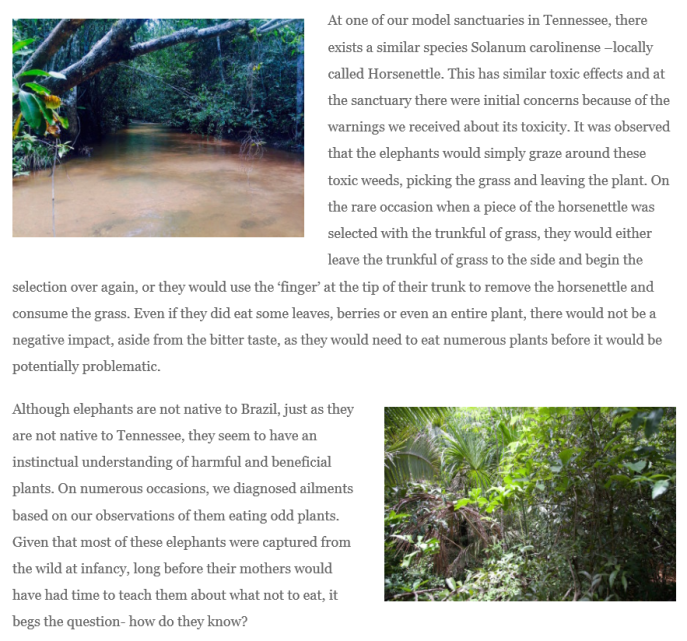
The Global Sanctuary for Elephants is developing a new refuge for elephants in Brazil, involving everything from installing steel pipe fences to assessing whether the local flora pose any health risks to elephants.

GSE reports that five countries in South America have banned elephant performances in circuses and shows.  This has resulted in elephants literally being sent to pasture, sometimes with inadequate care.  The goal of GSE is to complete a 2,800 acre natural refuge for a small herd of elephants.  Elephant Sanctuary Brazil is said to be the first and only elephant sanctuary in South America.

On their blog, GSE recently reported on an interesting consideration, which is that toxic plants could pose a risk to elephants who grew up without being exposed to that vegetation.  But GSE looked into it and found that elephants seem to have an instinctive understanding of which plants are dangerous even though their mothers never taught them to avoid them.  Check out what they learned from an elephant sanctuary in Tennessee:

http://www.globalelephants.org/elephants-and-toxic-plants/

The sanctuary will offer the opportunity to researchers to learn more about this behavior.

Tourist climbs 20 feet to elude tiger for 2 hours

Standard
Shah and Vaan Laan

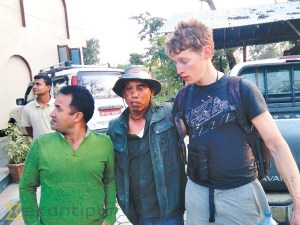
Krishna Shah (middle) and Gerard Van Laar (right). Photo from The Katmandu Post.

Tour guide Krishna Shah was injured while attempting to distract a Bengal tiger in Bardia National Park in Nepal.  His client, a tourist from the Netherlands, climbed a tree for safety.  The tour guide returned a couple hours later with backup to save Gerard Van Laar.  Kudos to Mr. Shah for returning to the site despite his own injuries to save the Dutchman!

The Metro has the story:

A Dutch tourist managed to escape from a prowling Bengal tiger by hiding up a tree for more than two hours.

Gerard Van Laar was walking in a Nepalese national park with his guide when they suddenly heard a growling roar and saw the animal ‘heading towards us at full speed’.

His guide Krishna selflessly saved the tourist’s life by running into the jungle to draw the tiger’s attention, and telling Gerard to climb the tree.

Tigers are capable of climbing sturdy trees but it is relatively rare for them to do so.

Freelance engineer Gerard, 33, said he was lucky to be alive after the attack on Saturday.

He had been trekking in Bardia National Park, around 250 miles southwest of the capital, Kathmandu.

‘I would have been dead if it had not been for Krishna,’ he told The Associated Press.

Krisha was attacked and slightly injured after he saved the other man, but escaped to raise the alarm.

As Gerard waited in the tree, the tiger returned and started circling while the man in the branches tried to stay as still and quiet as possible around 20 feet above the ground.

Around two hours later the guide came back with help, shouting and using sticks to drive the tiger away…

Review of Caught in a Past Reflection

Standard

Young couple Asa and Rebecca step through a portal in time into 19th Century America.  The novel Caught in a Past Reflection tells their story.

Rebecca works as a seamstress in modern day Colonial Williamsburg.  Her alcoholic mother makes home life unbearable.  Rebecca gets away from it with picnics in the woods with her new boyfriend, an apprentice silversmith from the other side of town.  She and Asa stumble upon a time portal in the woods.  Rebecca comes back later, alone, to start her new life in the past.

Although he enjoys a good life in modern times, Asa chases after her.  They reunite and begin their relationship anew in yesteryear.  Given the boom and bust cycle of American cities in those days, Asa and Rebecca must soon leave Williamsburg for Dumfries, Virginia.  There they live as a married couple and become better adjusted to the old days.  Asa is homesick but Rebecca flourishes.  Eventually they have to leave Dumfries to go west to Kentucky.  With each of their travels come unexpected dangers.

The strongest aspect of Caught in a Past Reflection is the two main characters and their relationship.  Rebecca and Asa are very well developed and the reader gets a sense of each of them as genuine people.  Their affection for each other is warm, intense, and believable.  Sometimes their love seems to be poured on a bit too thick, but that is balanced out somewhat by strains that crop up periodically in their relationship over the years.

Movies like “Forest Gump” and books like Winds of War use an everyman character to highlight big historical moments.  There is some of that in Caught in a Past Reflection, but Cochran mostly uses Asa and Rebecca to highlight smaller, ordinary aspects of early American daily life including work habits, food, social norms, gender roles, church life, and politics.  Although there is quite a lot of historical detail in the book, it is appropriate given the storyline and it does not suffocate the story.

The novel would best be categorized as historical fiction with a generous dose of science fiction and a dash of romance.  There is some suspense too finding out what happens to the couple in the long-run.  I recommend this book for readers interested in early American life.  Caught in a Past Reflection is available on Kindle for $5 or $18 in paperback.

Zoo makes Kevlar caps for elephant’s tusks

Standard

Oh Billy.jpg

The Denver Zoo called an aerospace engineer for help with dental problem.  Bill the elephant kept wearing down his tusks which could lead to infection.  Zoo staff needed a solution other than metal caps that would distract the playful Billy.  The result was a lightweight, ivory-colored cap made of fiberglass and Kevlar.  Kudos to the team in Denver for their innovative solution to maintain Billy’s health!  From the Denver Post:

Denver Zoo develops advanced technology to repair elephant tusks

Now, the zoo is being contacted by zoos across the country, asking for tips of the tusk trade.

By Elizabeth Hernandez The Denver Post

Posted:   02/12/2016

Billy had the elephant equivalent of a cracked tooth that needed a crown.

The solution — part dentistry, part engineering — patched up Billy and could help zoo animals around the world.

Billy, a 7-year-old Asian elephant who came to the Denver Zoo in 2013, is considered a kid at heart who loves digging in the dirt with his tusks, eating melons, tossing logs around and swimming. The pachyderm’s playful spirit started taking a toll on his tusks — modified teeth that continuously grow throughout elephants’ lives.

When zoo staff members Rachael Chappell and Dennis Donovan and zoo veterinarian Betsy Stringer noticed wear and tear on Billy’s tusks last April, they wanted to take action before the inner tusk became exposed and infection set in.

The team knew they would have to cap Billy’s tusks to protect them, but pre-existing caps were a cumbersome eyesore, often made of an eye-catching metal that would distract a young, inquisitive elephant like Billy.

“We decided it’s 2016, and we’re the Denver Zoo,” Donovan said. “Rachael mentioned they make carbon fiber wedding rings that are durable, and it just went from there.”

They contacted a local aerospace engineer who designed a lightweight, nonintrusive cap in about two weeks that would be fitted to Billy’s left tusk and would take the brunt of his horseplay.

The cap — made of fiberglass layers — matches Billy’s ivory and looks like the head of a cotton swab stuck on the end of his tusk.

“Billy’s very ‘Ooh, shiny object,’ ” Chappell said. “With this cap, he’s less likely to mess with it.”

Other benefits of the innovation include the ability to X-ray Billy to check on his tusk growth, which is not possible with the typical metal cap…