How to sell your military skills to a civilian employer

Standard

Job Search

The book Job Search by Lt. Col. (Ret.) David G. Henderson provides good tips on the transition from the military to civilian employment. In Chapter 1, Henderson encourages readers to think about–and actually write down–what skills they have, what job preferences they have, and what goals they have. It may sound hokey, but it is a useful exercise that will prompt you to learn something about yourself.

The subtitle, “Marketing Your Military Experience,” refers to translating your military skills to a civilian hiring manager. This includes how to describe your experience and strengths on resumes. The book also includes smaller, practical tips; for example, avoid using military acronyms and don’t wear military dress shoes in civilian interviews.

The book is also helpful as a general employment guide with thoughtful suggestions on how to search for jobs and how to improve your resume. Henderson’s guidance is relevant to anybody seeking a second career or making a mid-life jump from one field to a very different field, because that’s essentially what military retirees are doing.

I read the 5th edition which was published in 2009. Even though the Internet had already been around for a long time then, the descriptions of online job searches in this book are quite dated. There are good resources listed for job searching, career assistance, and veteran support services, but some of the resources seem dated as well. The appendices are a bit too long and redundant bordering on fluff, but those pages can be skipped or skimmed.

This book is written from the point of view of a personnel officer attempting to help a servicemember who is within six months from retirement. However, I think it would be useful to veterans even several years after they have separated or retired from the military. Spend a few bucks to make sure you’re putting your best foot forward during a career transition!
Review of Caught in a Past Reflection

Standard

Young couple Asa and Rebecca step through a portal in time into 19th Century America.  The novel Caught in a Past Reflection tells their story.

Rebecca works as a seamstress in modern day Colonial Williamsburg.  Her alcoholic mother makes home life unbearable.  Rebecca gets away from it with picnics in the woods with her new boyfriend, an apprentice silversmith from the other side of town.  She and Asa stumble upon a time portal in the woods.  Rebecca comes back later, alone, to start her new life in the past.

Although he enjoys a good life in modern times, Asa chases after her.  They reunite and begin their relationship anew in yesteryear.  Given the boom and bust cycle of American cities in those days, Asa and Rebecca must soon leave Williamsburg for Dumfries, Virginia.  There they live as a married couple and become better adjusted to the old days.  Asa is homesick but Rebecca flourishes.  Eventually they have to leave Dumfries to go west to Kentucky.  With each of their travels come unexpected dangers.

The strongest aspect of Caught in a Past Reflection is the two main characters and their relationship.  Rebecca and Asa are very well developed and the reader gets a sense of each of them as genuine people.  Their affection for each other is warm, intense, and believable.  Sometimes their love seems to be poured on a bit too thick, but that is balanced out somewhat by strains that crop up periodically in their relationship over the years.

Movies like “Forest Gump” and books like Winds of War use an everyman character to highlight big historical moments.  There is some of that in Caught in a Past Reflection, but Cochran mostly uses Asa and Rebecca to highlight smaller, ordinary aspects of early American daily life including work habits, food, social norms, gender roles, church life, and politics.  Although there is quite a lot of historical detail in the book, it is appropriate given the storyline and it does not suffocate the story.

The novel would best be categorized as historical fiction with a generous dose of science fiction and a dash of romance.  There is some suspense too finding out what happens to the couple in the long-run.  I recommend this book for readers interested in early American life.  Caught in a Past Reflection is available on Kindle for $5 or $18 in paperback.

After the Crash partly succeeds

Standard

A plane crashes in France.  All passengers are killed except an unidentifiable baby girl.  The premise of After the Crash, a newly translated thriller by Michel Bussi, sounds unbelievable and silly.  But the more you read, the more plausible it becomes.

A custody battle ensues between possible grandparents from the rich de Carville family and possible grandparents from the poor Vitral family, each with plausible claims that the baby is theirs. Custody of Lylie, as she comes to be called, is awarded to the Vitrals, who are also taking care of their grandson, Marc. After 18 years, Marc has developed an attraction for Lylie, who does not look or act like the rest of the Vitral family.

After the custody battle, the de Carvilles hire a private eye, Credule Grand-Duc, to keep investigating the case. He uncovers many clues but mostly dead ends in a maddening 18-year search.  Throughout the novel, Marc is reading passages from Grand-Duc’s journal about the case.  That is primarily how we learn about validity of the competing families’ claims.

The story is mysterious and suspenseful. Bussi intentionally frustrates the reader by withholding crucial information.  For example, after Grand-Duc writes that he arranged for a secret DNA test, he doesn’t record in his journal what the results were.  Instead he simply writes about how shocked and dismayed he was by the results.  Much of the book is like that—one tease after another.  The teasing starts out fun but becomes tedious and annoying.

Bussi wants the readers to root for Marc and Lylie’s relationship. Several of the main characters hope that Marc and Lylie aren’t actually brother and sister so that they’re love affair will be acceptable.  However, the whole concept grossed me out.  Even if they are not biological siblings, they still grew up together.  Their romance didn’t work for me.

Some of the prose is stilted and the word choice is uneven, which I assume is because of the translation.

If you want to read a clever mystery that doesn’t start with a murder, this book will fit the bill.  There’s enough intrigue, clues, and red herrings to motivate you to keep reading.  But overall, the purposeful withholding of information got old. I wanted the book to end.  For that and the incest/yuck factor I’d give this book a two-star rating.

Corrupt general gets the payback he deserves in Two Thieves and a Puma

Standard

Toward the end of the Indian wars, the U.S. military surplused property it no longer needed.  A few corrupt supply officers and clerks cashed in by selling property off the books.  The Western Two Thieves and a Puma (1980) by John Reese tells the story of two men, one who served as a general and one who was a sergeant, who participated in such siphoning.  The fates of the two men are tied together because they marry a pair of Italian-American sisters, whose family is always looking for financial opportunities.  Each of the men go into the cattle business for themselves on neighboring ranches in California.

Decades later, the wife of the former sergeant Whiting has died.  He is struggling to make ends meet because his herds have diminished.  Meanwhile, the ranch of former general Hethcutt, who is arrogant and incompetent, is thriving somehow.  A high number of Hetchutt’s cattle exhibit Shorthorn traits although Whiting was the only one of the two ranchers to buy Shorthorn stock.  Whiting keeps a detailed, encoded log book of Hethcutt’s cattle to use as evidence in a cattle rustling lawsuit.

Whiting’s property is often used Lon Tsan, a roving opium den operator.  Lon Tsan has mostly Chinese customers.  His other main customer at Whiting’s ranch is a cougar named Sneaky.  The puma had been orphaned and raised as a cub by Whiting’s daughter.  The puma becomes partly domesticated and totally addicted to Lon Tsan’s product over the years.  Although the premise sounds far-fetched, it works.  Sneaky becomes a lovable, sympathetic, and not entirely docile character throughout the book.

Jefferson Hewitt, a full partner and field agent of a bonding company (a detective, really), arrives and offers to help Whiting with his claim.  Hewitt is an excellent marksman with sufficient resources to hire a lawyer for Whiting and a temporary gang of men to pull security around the ranch.  Although Whiting has a very solid lawsuit, he suspects Hewitt is involved in the case for bigger, undetermined financial reasons.  Those reasons don’t become clearer until the final third of the book.  The action culminates to a final confrontation between the forces of Whiting, Hewitt, Lon Tsan and Sneaky versus the forces of Hethcutt.

Overall, Two Thieves and a Puma is a great read.  Although nobody in the story is without blame, it’s satisfying to watch the little crook take on the big crook and win.  In this regard, the book is similar to the Walter Matthau movie “Charley Varrick,” which was based on a book also written by John Reese.  The characters in Two Thieves and a Puma jump off the page, warts and all.  The financial intrigue is very compelling and Reese has a good sense of timing for revealing critical tidbits and explanations as the plot progresses.

It’s impossible to describe without spoiling the end, but there is an aspect of the ending that isn’t very good.  I wish Reese had written the ending just a little differently.  But overall the book was excellent–very satisfying, tight, clever, and lively.

Dogs get second billing in The Search

Standard
The-Search

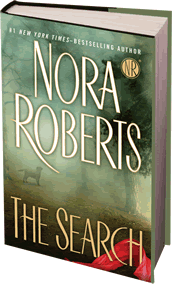
The Search by Nora Roberts

Fiona Bristow foiled an attack against her by a serial killer.  Years later, a seeming copycat is intent on finishing the job her original assailant couldn’t.  The Search, a 2010 novel by Nora Roberts, is the story of Fiona and the romance she develops with her new boyfriend Simon while the copycat closes in.  She’s a strong and scrappy woman; Simon is a strong and superficially insensitive man who simultaneously makes her heart sing, curls her toes, and stands side-by-side with her to face down the threat.

The Search is well-written, suspenseful, the characters are engaging, and it’s all designed for a female audience.  I read it because it appeared on lists of books involving military or search-and-rescue dogs.  Dog training is a consistent element or theme throughout the book.  Fiona trains dogs for a living and does search-and-rescue work as a volunteer.  Her job and the volunteer work are successfully woven into the storyline.  However, the dog training seems to be a one-dimensional tool that Roberts uses to reveal Fiona’s character and to give Fiona insights into her would-be killer.  The dogs get assigned names and a couple personality traits, and the reader learns a bit about search-and-rescue operations, but it’s a little thin.  The dogs don’t get quite as much attention or reward in the end as I would think they deserve.

That being said, Nora Roberts intended to write a woman-in-distress romance and not a search-and-rescue book, so it’s not her fault I picked up a copy to read.  I cannot fault Roberts because some people may have exaggerated the extent to which this novel focused on search-and-rescue dogs.  Roberts did a great job and wrote a satisfying conclusion, so I give it four stars out of five, but this book really wasn’t for me.

The Review that I Almost Forgot

Standard

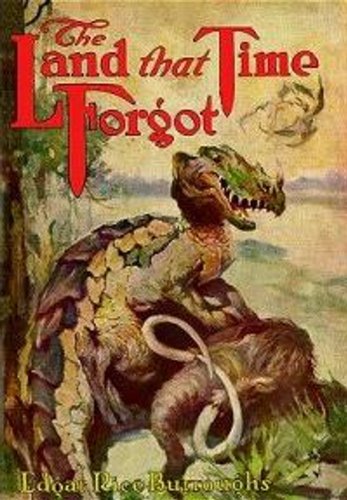
The Land that Time Forgot book cover

The Land that Time Forgot, written by Edgar Rice Burroughs, has a wonderful title.  Just hearing the title conjures up a marvelous daydream.  And it’s a good description of what the book is about.

Burroughs wrote the book a few years after Arthur Conan Doyle’s Lost World was published.  The story is very similar:  a group of Westerners arrive at a previously undiscovered and untamed land of dinosaurs.

But it takes a while—nearly half way through the book—before the characters in The Land that Time Forgot discover the island where dinosaurs live.  There’s a long backstory beforehand of an American and Britons who are captured by Germans during World War I.  The Allies manage to take control of their captors’ U-33, but they cannot convince any other vessels to take them to safety.  The Allies and Germans are forced on a voyage to nowhere.  This allows plenty of time for an on-again, off-again romance to develop between the American protagonist, Tyler, and Lys La Rue, an Englishwoman.  Matters are complicated by Lys’s suspicious affection for von Schoenvorts, one of the German officers.

Running out of supplies and hope, the hybrid crew discover “Caprona.”  The mythical island is rumored to have been seen by an 18th Century Italian explorer somewhere between South America and Australia.  Much like the plateau in Lost World with cliffs so steep to discourage exploration, Caprona is almost impenetrable.  The reason for the U-boat finally becomes clear:  the submersible is able to navigate under the ocean’s surface and up the mouth of an island river inland.

The crew wastes little time spotting, hunting, and eating the dinosaurs as quickly as they emerge from the river.  (Broth from Plesiosaurus neck bones is their first and cleverest recipe.)  Yet Burroughs does not have the passion or scientific interest in dinosaurs that Doyle seemed to have; the descriptions of the dinosaurs’ appearance and behaviors are somewhat short.

Again, like Lost World, the group discovers that they are not the only hominids in the dinosaur wilderness.  They become involved in the island people’s intertribal turf battles.

You may find yourself looking for a social commentary under the surface about World War I.  If there is such a theme, it’s pretty thin.  This is not a book about overcoming ethnic or language differences to make peace with adversaries.  It’s not a book about the follies of war.  The use of the submarine and the opposing factions of personnel seems to be tools of convenience to further the plot, and nothing deeper.  That may be refreshing to readers who aren’t looking for anything too heavy.

While not quite as good as Lost World, there are a couple of winning elements in The Land that Time Forgot.  For starters, the original Lost World was only men.  (All the movie versions of Lost World recognized that shortcoming, and created a female character to join the expedition.)  The romance in The Land that Time Forgot adds a more human dimension and clearer motivations for the lead characters.  Secondly, the possibility that the Germans are working to undermine the Allied crew adds suspense and nuance to the story.

Another highlight of the book is Tyler’s tenderly and realistically described Airedale terrier named Nobs.  When the dog sees dinosaurs for the first time, Tyler observes that “poor Nobs had nearly barked his head off; and I think, too, that for the first time since his littlest puppyhood he had known fear; nor can I blame him.”

You’ll want to find out what happens to Tyler and Lys (and Nobs), and whether they’re able to escape the island alive.

“Rogue” scares and satisfies

Standard

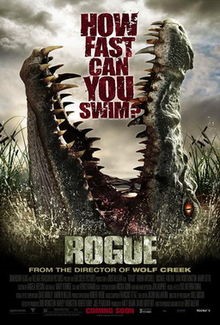
Rogue 2007

In the 2007 movie “Rogue,” Michael Vartan plays Pete McKell, a travel journalist who normally writes reviews of hotels, glamourous attractions, and restaurants.  Pete gets more than he bargained for when he joins a boatload of tourists on a ride upriver for a glimpse of saltwater crocodiles and other wonders in Australia’s rugged Northern Territory.

Kate Ryan, played by Radha Mitchell, runs the river tour company and skippers the flat-bottomed boat.  She is a tough, attractive, and sympathetic character who has never left the Northern Territory.  She and Pete develop a chemistry early on, and viewers can quickly predict how their relationship will develop.

Kate has to put up with a pair of human pests who harass her tour boat.  She must also contend with her own passengers who question her decision-making as the story progresses.  The tourists are a mixed lot of thrill seekers with their own strengths, weaknesses, and secrets—maybe just one aristocrat short of an Agatha Christie cast.

As viewers will guess, the boat quickly ends up in the territory of a particularly dangerous crocodile.  Ryan and her passengers have to attempt to fight their way back to safety.  This movie would appeal to fans of classic creature features like “Birds” and “Jaws.”  Unlike “Godzilla” or “Jurassic Park,” this is not a film about the hazards of scientific excess.  It’s about a big, old-fashioned natural predator and a series of missteps that leads a group of people deeper into trouble.  The fun and suspense is in seeing who gets offed and how any survivors escape.  The Australian vistas and realistic crocodile effects are also a treat.

The DVD can be bought on Amazon for $12.  Recommended with pizza and beer.

Review: Arthur Conan Doyle’s Lost World

Standard

Turning through the first few pages of Sir Arthur Conan Doyle’s most famous book that wasn’t about Sherlock Holmes, one feels the immediate excitement of embarking on a great adventure in an exotic location with an impossible threat.  In that sense, Lost World resembles Bram Stoker’s Dracula or Mary Shelley’s Frankenstein.

The pompous, iron-willed Professor Challenger, naïve news reporter Malone, Blackwater contractor big game hunter Lord John Roxton, and the search party’s skeptical Professor Summerlee set out to prove or disprove Challenger’s claim that dinosaurs are living on an isolated plateau in the Amazon.

The group journeys to the location, but the path they took is immediately and mysteriously cutoff.  Since they cannot go back, they take advantage of the scientific opportunity to explore the lost world.  The presence of dangerous dinosaurs is soon confirmed, but what makes the novel most engaging, credible, and chilling is what happens next.  It turns out that the Brits face an indigenous foe more dangerous than dinosaurs—man.  This compelling aspect of the storyline is often skipped or glossed over by movie versions of Lost World.

The imperial arrogance and racial depictions in the book will rub many contemporary readers the wrong way.  But those who are willing to accept that those were the prevailing attitudes of readers in Doyle’s era, and focus on the adventure instead, will find a tale well worth reading.