Book Review: Bone Labyrinth is over-the-top fun

Standard

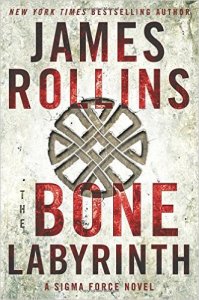
Bone Labyrinth

Congo meets Da Vinci Code.  Primate and human intelligence are explored against a backdrop of old Catholic secrets.  Throw in a larger than life team of heroes, stylish international travel, nail-biting firefights, nasty villains from China, and more narrow escapes than a Hardee Boys book, and you’ve got James Rollin’s Bone Labyrinth.

Bone Labyrinth alternates between an A-story and a B-story, each focused on one of two brilliant sisters separated by an ocean, and each accompanied by half of “Sigma Force,” an ultra-elite team of quasi-military-spy characters.

One sister, Maria, is the surrogate mother for Baako, a gorilla hybrid who is smarter than normal (and at least in the beginning, appears to be psychic as well).  Her love for Baako and his love for her proves that she is as tender and caring as she is brilliant.  Kowalski, a member of Sigma Force who knows sign language, is rough around the edges, but is able to communicate with Baako, thereby eventually earning love and respect from Baako and Maria.  They are all kidnapped for the secrets of Maria and Baako’s minds.

The other sister, Lena, has a knack for finding historical sites in Europe and South America that are easy to be trapped in by foreign assassins who are always right on her tail.  Thanks to Sigma’s Gray, who can see patterns when nobody else can, and his lover Seichan, who acts like Catwoman most of the time, Lena is protected as she finds one clue after another about the origins of human life, but not without almost being drowned or shot at every turn.

The alternating plotlines and groups of characters may not be for all tastes.  On one hand, the dichotomy keeps things moving along, creates cliffhangers, and prevents boredom with one topic or series of scenes.  On the other hand, it’s one tease after another.  Usually the switches result in delayed gratification, stretching out the resolution to whatever conflict the characters find themselves in, but there are some instances where the switching is just a tease without gratification.

Bone Labyrinth is an ambitious novel, offering the possibility of explaining the moment in evolution known as the Great Leap Forward, or explaining Adam and Eve, or both.  The book is like a treasure hunt, but the treasure is the understanding of human intelligence rather than material wealth.  By that measure, Bone Labyrinth doesn’t hit the bullseye, but at least it goes in the direction of the target.

It is a fun novel.  The characters all have their own back stories and very specific traits, and from that standpoint they are well developed.  They each have some weakness to balance out their enormous gifts and talents.  But I think even James Rollins would admit that they’re all a bit over the top.  I think it’s intentional, because it is kind of fun to watch these combat geniuses at work.

If you love thrillers, or loved reading adventures as a kid (I really wasn’t kidding about the Hardee Boys similarity), you will enjoy this book like I did.  Rollins’s ability to make science and history thrilling is impressive, but don’t expect it to be quite like a Michael Crichton book—ultimately Bone Labyrinth’s fun characters and rapid-fire action scenes are what animate this book, and science very important but somewhat secondary to that.
Book Review: Cybersecurity for Everyone

Standard

Cybersecurity for Everyone: Securing your home or small business network by Terence L. Sadler is an informative guide to securing your electronic devices at home.

One risk of writing or speaking about cybersecurity is that it can quickly devolve into “gloom and doom” that terrifies audiences, sends them away chilled, but results in no behavioral changes among computer users.  Sadler’s approach is different, focusing less on threats and more on preventative measures.

Cybersecurity for Everyone compares information security to safe sex:  the only guarantee against contracting an STD is abstinence, and the only guarantee against a compromise of your network is to not have a computer.  Since there are no guarantees on computers, the best we can do is use appropriate prophylactics and practice safe habits.

Sadler suggests starting with router security.  Until reading this book, I did not realize how vulnerable to intrusion typical residential routers can be, or that superior models and configurations are available.  One thing computer owners can do is to blacklist all electronic devices but their own, or expressly whitelist their own devices.  Sadler also suggests using a service like OpenDNS for home internet security.  A few suggestions in the book may go overboard, but I’m glad to know what the best practices are so I can make informed decisions, rather than mindlessly renewing my anti-virus protection every year and patting myself on the back for it.

The book is a pretty quick read, and it provides valuable context for understanding of cyber threats and safety measures.  It came out in late 2014, but is still fresh.  There are some tables and lists of resources that will probably become dated quickly or already have, but I mostly skipped over sections.  To me, the more important takeaway was the basic point that amping up your security at home is feasible and affordable without sacrificing performance.

As for the title, this book isn’t really “Cybersecurity for Everyone.”  It’s more like “Cybersecurity for Fairly Technically Literate People,” or “Cybersecurity for Whoever It Is in Your House That Installs Stuff.”  Much of it would sail over the heads of people who don’t already have some interest or knowledge of technology.  Furthermore, the subtitle of the book adds “or small business network,” but the tips within are truly geared toward a household, not to businesses.

Book review: The Looters is an overlooked gem

Standard

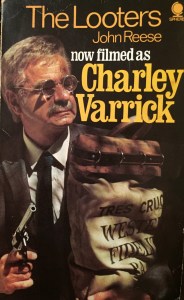
Bank heist book cover

What an underappreciated storyteller was John Reese.  In some ways an heir to James Cain and Dashiell Hammet, Reese was able to create visceral plots infused with palpable greed, criminality, and menace in sunbaked California landscapes.

The Looters (1968) was billed on some book covers as “The exciting and violent story of a bank robbery.”  Indeed, the book includes such a story, but that doesn’t do it justice and the story doesn’t end there.  The Tres Cruces National Bank isn’t exactly as clean and pure as the wind-driven snow.  Investigators initially suspect that the robbery was an inside job orchestrated by somebody within the shadowy, mostly Italian owned parent entity that controls the bank.

Everybody loves money, but few people like numbers or financial complexity.  Even fewer can tolerate reading about the subject.  Reese is one of those rare authors who is able to convey a complicated financial caper to thrill his readers rather than crossing their eyes.  He did it with Two Thieves and a Puma and again with this book.  His quirky characters and their motivations are what carry the readers through the turning points in his plots.  Reese also usually takes time to explain what the financial interests of the different players are so readers don’t get lost.

In The Looters, Reese also shows that he is the master of creating characters who are complete jerks.  Take J. J. Schirmer, a bank executive who is not only prejudiced against Italians (constantly referring to his business partners as greasy Sicilian bastards or “Sicilian perverts”), he’s vile to work for.  In one of several scenes like it, Schirmer needlessly berates his driver, Eddie, at 8 a.m.:

Schirmer put down the phone and shouted for Eddie.  The chauffeur had slept in the lounge outside, and was still not dressed. ‘I been waiting to hear you was awake, Mist’ Schirmer,’ he said.

‘All right, you heard. Go get me a pot of coffee.’

‘I cain’t go like this, seh. I phone for it and have it here before—’

‘God damn it, I could have phoned for it. I want to use the phone!’

‘I go fetch it.’

‘Never mind! I’m going to take a shower. Call for some coffee and then put in a call for Sybil at her place.’

The Looters is filled with deliciously nasty dialogue like that, and characters like Schirmer who show their cruelty, caprice, and superiority complexes at every turn.  Molly, a hired gun working for the Italians, is a world-class sadist and creep tasked with hunting down the bank robber before law enforcement gets him.  They are all harsh to take, but fun to read about.

The downside to the host of characters is that there isn’t a single antagonist or a single hero.  There are good qualities and bad qualities on all three sides of the character triangle:  the bank robbers, the bank owners, and law enforcement.  The lack of a single main character gives the book a different style and impact than the movie, which focused on Varrick (and made him more genial than the hard and ruthless robber in the book).

Reviews of this book have noted that the ending is different from the movie.  That is true, and in several ways, the film’s ending is superior to the book.  The memorable biplane chase from the movie is nowhere to be found in the book.  Whoever came up with that idea for the movie deserves credit for the exciting addition, which was quite sensible considering that Charley Varrick and his partner were crop dusters in the book.

The book’s ending was jarring.  The scene where Molly finds Charley occurs too suddenly, with very little build-up.  It would have been improved if Molly had to chase a few more leads prior to finding Charley, and if their physical confrontation had been more drawn out.  Because of that and the murkiness about the main character, I bump this book down from five stars to four.

That being said, this is still a sweat-inducing pistol of book ideal for a late-summer read.

Book review: Where Angels Prey is informative read

Standard

Indian financial thriller

In Ramesh S. Arunachalam’s thriller, Where Angels Prey, Bob, a Western journalist, arrives in India to write an article about Prasad Kamineni, a micro-finance executive.  He teams up with Chandresh, an eager local journalist aware of the darker side of micro-finance in India.  Veena Mehra, district magistrate of Ranga Reddy (in Andhra Pradesh), is also conducting an investigation into Prasad’s business.

Many of the micro-finance debt collectors, including those employed by antagonist Prasad’s SAMMAAN bank, are conducting loan shark style tactics.  They humiliate and threaten borrowers to the point where the debtors, such as a sympathetic widow named Mylaram, commit suicide.  Another case unfolds during the action of the book, where Rammaiyya, who was going to serve as an informant against SAMAAN, is mysteriously killed.  These cases are a continuation of the ruthless tactics used by money lenders that Maoist insurgents fought against in earlier decades.

Micro-finance is a much celebrated concept in the West, and the leaders of the micro-finance movement such as Muhammad Yunus are lionized as heroes ushering in a new era of equity and opportunity in the developing world.  This informative book sheds much needed light on a concept that is not so rosy in reality.

 As narrative fiction, Where Angels Prey could have been improved.  The syntax takes some getting used to for an American reader.  While the author is a skilled writer, there are grammatical oddities and formatting issues that could have been reduced with a more professional editing job.  The present tense verb choice throughout the narrative is awkward.  A constant parade of characters gets confusing, especially since many of them are not substantially developed.  Just as soon as you learn about a new character and start to get a feeling for him or her, they disappear.  It is more of an “ensemble cast” than a book with a single main character. Either Bob or Chandresh is the hero of this financial thriller, but the story probably would have been strengthened by picking one of them to develop further.  Veena’s investigation was duplicative of the journalistic one.  Also, there is a lot of “telling not showing”: abusive tactics are described in general, rather than experiencing them all through eye-witness accounts in real time.

On the plus side, the novel was suspenseful.  One wants to learn how it all turns out for Prasad, who is a compelling villain who is also sympathetic in several ways.

People who are interested in predatory lending, poverty, international development, and socioeconomics should check this novel out.

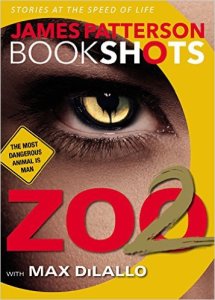
Book review: Zoo 2 is fast and fierce

Standard

2016 thriller novella cover

Clever scenes, exotic locations, and, for an animals-attack thriller, nothing too over the top.

James Patterson’s Zoo 2, which Patterson and his marketers call a “bookshot” is actually a novella and a sequel to the longer 2012 novel, Zoo.  It picks up where the original left off, with intrepid, un-credentialed scientist Jackson Oz and his family in Greenland taking refuge from the resurgence in animal attacks ongoing in the U.S. and other temperate regions.

The President summons Jackson back into action.  Jackson decides to leave his wife Chloe at her parents’ home in France while he goes to research the possible spread of aggressive behavior from animals into isolated human cases.  Some readers don’t seem to like the concept that “humans are evolving” in this sequel.  There is a ‘feral human’ story line, and it worked for me!  The dangerous human theme doesn’t go overboard into full zombie apocalypse mode, but it’s a serious enough threat that it changes the dynamics from the original Zoo book or the “Zoo” TV series. If this sequel had only been another series of animal attacks, it probably would have unsatisfying, boring, or both. The feral human angle gave it an extra dose of horror.

Zoo 2 is well-written—a step-up in professionalism compared to some other monster novels out there.  (This may be thanks to Patterson’s co-writer, Max DiLallo.) The shorter novella platform was just right for the subject matter and for me. A quicker read than the original Zoo with fewer hokey set-ups.

The only thing I didn’t like about the book is something that happens early on at Chloe’s home in Paris.  Let’s just say that two people end up dead, when killing off one character would have worked just as well.  Especially considering that Chloe didn’t seem to be that upset—you think she’d have been devastated, possibly for the rest of the book.

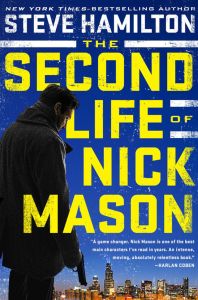
Book review: Two Stars for Second Life

Standard

second-life-of-nick-mason-steve-hamilton-review

Clever idea that got off track.

A Chicago mob boss in prison arranges for the release of a fellow inmate 5 years into a 25-year sentence to become his assassin on the outside.  Once free, Nick Mason, a former car thief, finds out that being released to kill people is worse than being in prison, even though his targets are mostly dirty cops.

It is an intriguing concept.  Quintero, Nick’s handler on the outside, tells Nick early on that freedom is different from mobility—don’t get the two confused.  Great line.  And it sums up the plot of the novel.  Nick is mobile because he left prison, and can basically go where he wants, but he’s on call 24/7 to carry out a hit.  The mob boss, Cole, controls Nick, and threatens his family if he tries to wiggle out of the 20-year deal.

However, for a man who had only stolen cars to become a cop killer almost overnight is tough to swallow.  He’s able to run circles around all of his targets and almost all of the other characters in the book.  Maybe if Nick made more mistakes, or had a somewhat darker past, it would be more plausible.

Just as easily as Nick becomes a master assassin, he proves himself to be quite the lady’s man, quickly meeting a woman who wants to know “what five years feels like.” Eh hmm.  Most of the female characters seem interested in either getting in bed with Nick, or with scolding him for ruining their lives in the past.  There’s not much middle ground.

While Nick is running around killing people, a homicide detective named Sandoval is on the trail of the corrupt cops.  The scenes involving Sandoval and the SIS, an elite police unit, are a bit complicated and tricky to follow.

I listened to the audiobook which was a mistake.  The narrator’s tone was extremely bitter in the first 20 percent of the book, which makes some sense because it is set in prison.  However, some lines that I would have read as factual commentary are dripping with venom in the audiobook.  In other words, the tone was overkill.  The mob boss’s voice sounds like a cross between Lucious Lyon from “Empire” and Barack Obama, which was distracting.  Each female character sounded identical, flippant, and naggy.  The narrator has great vocal talents but overall this narration didn’t work for me.

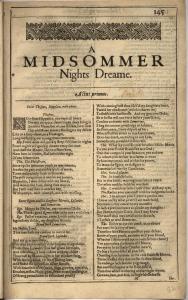
Review: A Midsummer Night’s Dream

Standard

Old-fashioned looking page from Shakespeare's play

Get ready for sex and a big party!  So says Theseus, Duke of Athens: “Stir up the Athenian youth to merriments.”

Now comes Egeus, unable to govern his own daughter, with a complaint.  The overprotecting father is incensed about the sweet things young Lysander has done to woo his Hermia, rebuking Lysander’s “feigning voice, verses of feigning love.”  He wants Hermia to marry Demetrius instead.  Let me kill her if she disobeys me, Egeus tells Theseus.

Theseus tells Hermia “your eyes must with his [your father’s] judgment look.”  He gives her until his own wedding date with war bride Hippolyta to make up her mind.

Hermia attempts to elope with Lysander, but she is chased by Demetrius into the woods.  Helen, Hermia’s friend, chases after Demetrius, hopelessly in love, telling him “I am your spaniel.”  More insightfully she adds, “We cannot fight for love as men do:  We should be woo’d, and were not made to woo.”

Elf king Oberon sends his jester Puck to spread love potions around.  Lysander, under the influence, falls for Helen, asking her, “Content with Hermia? No:  I do repent / The tedious minutes with her have spent.”

Theater people plan a production for Theseus’s wedding.  Their hope for the ladies in the audience is “not to fear, not to tremble.”  They settle silly details about the play, and Quince adjourns them, saying “Come, sit down, every mother’s son, and rehearse your parts.”

Bottom plays Pyramus, who wears an ass’s head.  Oberon’s queen awakes to fall in love with Bottom, who says “reason and love keep little company.”

Oberon sends Puck to fix his mistake with Lysander by making Demetrius love Helen.  She thinks both men are mocking her and complains excessively.

Oberon and Puck make things right:  Titania comes to her senses, Lysander loves Hermia again, and Demetrius keeps his love for Helen.  Upon Demetrius explaining his feelings to Theseus, the Duke says, “These couples shall be eternally knit” in a triple wedding ceremony.

In the play-within-the-play after the wedding, Pyramus thinks his lover Thisbe has been killed, so he kills himself.  Finding his body, Thisby does the same, in the style of Romeo and Juliet.

In the final scene, Shakespeare says it’s late, and tells everybody to have a good night.  Wink, wink.

A Midsummer Night’s Dream is a fairly quick read, appropriate for spring or summer, with great lines about the fickleness of love.  We should each read it at least once in our lives, no?

Movie review: “War Horse” the tear-jerker

Standard

Shot from War Horse

It pulls your heart strings right out of your chest.  Steven Spielberg, you stinking genius!  How do you do it, time and time again?

You start with a grown-up, flawed but wise.  Then you add a young person, precocious and special.  Mix in a creature, wild and untamed, that has a connection to the youth.  Then fold in tragic external events which complicate the bond between the youth and the enchanting animal.  Add dashes of evil, goodness, comedy, and syrup.  Bake for two hours and enjoy!  Or just cry your eyes out.

No, it’s not “E.T.,” “Gremlins” or “Jurassic Park,” but “War Horse” (2011).  Yes, I’m way overdue in watching it, but since it is set during World War I, it’s not a time-sensitive movie that requires immediate viewing.

That being said, there has been a great surge in interest in military working dogs since the inception of the wars in Afghanistan and Iraq.  To me this movie felt like a natural extension of the newly rediscovered affection for animals in military service, but with horses instead of dogs.

The movie also gave Spielberg, and the rest of us, a chance to look back at the Great War.  Unlike World War II, which is the setting for many of Spielberg’s films, World War I is less morally clear, with good people on both sides of the conflict.  The English, French, and Germans are all presented sympathetically in “War Horse,” with horse-friendly humans among the armies of the Allies and the Central Powers.

The plot is not quite as predictable as I laid out in the Spielberg template above.  At the beginning, it seems that Joey, the leading horse, could become a racehorse (or maybe I had Black Stallion, Seabiscuit, and Secretariat on my mind).  Then it seems he’s destined to be a plow horse, then a cavalry horse, then fill other roles, but it’s rarely obvious where the war will lead Joey next.  Whether and how Joey will be reunited with Narracott, the boy who raised him, is key to the atmosphere of suspense and longing in the movie.

The landscapes of the English and French countrysides, including the Narracott cottage, are breathtaking.  The trenches and no man’s land of the battlefront are stark and horrifying.  The camera work and horse effects are real, even painful to watch at times, earning the movie its PG-13 rating.  It’s a beautiful film.

It is also maudlin and manipulative, sending stern Germans and stiff Englishmen into temporary truces for their mutual love of a beautiful, unfairly victimized horse.

Watch it, learn from it, and be prepared to discreetly wipe your eyes while you enjoy it.

Book review: funny crooks Down on Ponce

Standard

Money laundering noir from Atlanta in the 1990s

James knocks on Sam’s door and asks him to kill his wife.  Sam asks, “Ever thought of divorce?”  James hadn’t.  Thirty thousand dollars later, Sam relents.  He promptly double-crosses James, tells his wife, and keeps the cash.  It’s all fun and games until somebody else kills James and his wife and burns down Sam’s mobile home.

The strong opening is followed by Sam going into hiding in plain sight on Ponce de Leon Avenue in east Atlanta.  He hooks up with a crew of colorful crooks: Charley who works at a funeral parlor and drives around town in a hearse, Bob who can’t talk but writes poems, and amputee Stinky.  Later they’re joined by Bug, a wisecracking lady’s man lunatic they help bust from an asylum, who may only be pretending to be crazy, but is insane enough to love killing his posse’s enemies.

We learn that people who live on the streets, especially criminals, are better adjusted than those dangerous freaks in the suburbs.  That’s the order of affairs in Down on Ponce, the 1997 novel by Fred Willard.  Street people’s approach to theft is individualized; suburbanites’ approach is institutionalized.  This is illustrated by the savings & loan crisis that preceded the action in this book but is alluded to, and the drug trafficking and money laundering that was ongoing from the time period of the book to the present day.  The cops in North Georgia don’t care because they see it as the natural evolution of moonshining, or something.

Sam figures that James was involved with a money laundering ring run by Dong Chandler.  Sam’s plan is to trick Dong into believing that his crew is experienced in laundering money through the Dutch Antilles or Costa Rica.  That way they can steal the money and figure out who burnt down Sam’s mobile home at the same time.

Sam is a sharp protagonist.  Maybe too sharp.  His foresight and leadership over the crew are on par with Robin Hood.  His morals are more variable.  He always stays a step ahead of his opponents, and outwits them in every conversation.

Sam’s fellow travelers are eccentric and constantly craclomg jokes.  They get embroiled in random, comical situations. Willard’s writing style is entertaining and even joyful—he seems to love being in the company of the characters he creates, and it’s infectious.  It’s a humorous book, and its humor helps distract from the excessive anti-suburban, anti-conservative, and anti-institutional messages of the story.  The book is also so funny that after a while you stop taking the book seriously.  It’s marketed as “hard-boiled” or “cracker noir,” but the levity of the constant gags undercuts the hardest edges.

Three stars out of five.

Review of Zoo: The Graphic Novel

Standard
Chimp looks at Manhattan by moonlight in Zoo: The Graphic Novel

Chimp looks at Manhattan by moonlight in Zoo: The Graphic Novel

Zoo: The Graphic Novel is better than the original book, Zoo.  The book was fast-paced, but became tedious about two-thirds of the way through.  Not so with the graphic novel, which remained engaging throughout.

It’s the exact same story:  grad school dropout Jackson Oz studies increasing cases of “human animal conflict” (HAC).  Scientists and politicians delay the research for a cure because they don’t believe Oz.  By the time they acknowledge it, it’s almost too late to pinpoint the cause and the solution.  Without spoiling anything, the solution has downsides that the people in power don’t like, so once again Oz finds himself in the minority.  He wants the solution fully implemented but everybody else is too stuck in their ways to accept wholesale change.

The pictures helped tell the story and cut down the need for text descriptions of setting, animal appearance, and animal behavior.  For example, the scene of Oz following a dog into a dog lair, which helped him uncover a key clue about HAC, was handled much more efficiently in the graphic novel in just a few panels than in the book, where that story seemed to stretch on for multiple pages.

As in the book, Chloe transitions from being a scientist with independent expertise into a stay-at-home mom.  However, the graphic novel smoothed it out a little, with Chloe retaining some strength and independence, whereas the book presented her as Oz’s fawning doormat.  However, Oz’s character development was probably stronger in the book than in the graphic novel.  Oz in the graphic novel is too distant—I couldn’t really get a good feel for him as a person.

Amazon reviewers have complained about the graphic novel being black and white.  The lack of color struck me as odd at first, but once you get into it, you forget about it.  In some ways it helped—it’s easier to make out character features and details in the animal’s faces in black and white.  Too much color can be a little distracting and intense.  Maybe they also wanted to keep it family friendly without a bunch of red blood splattered on the pages.  The drawings of Oz’s chimpanzee Atilla are very well done.

If you already read the book and you’re watching the CBS miniseries “Zoo,” or if you’re planning to read Zoo 2 (Patterson’s new novella) then reading the graphic novel is a great refresher on the original story.  If you never read the original book, just skip it and read the graphic novel.