Book review: Zero Alternative skewers “too-big-to-fail”

Standard

Pageflex Persona [document: PRS0000035_00017]

From the recession of 2008 was born a litter of woes.  Mortgage defaults.  Foreclosures.  Cram downs.  Lay-offs.  Furlough days.  Stagnant wages.

Was the recession caused by exotic financial instruments like mortgage-backed securities?  Was it the result of excessive pressure from the federal government on banks to issue home loans to borrowers who couldn’t pay the bills?  Or just the boom and bust of the business cycle?

That’s not the way that Scott “Yours” Walker (surely, an unintentional homonym with no relation to the governor of Wisconsin), the main character in Luca Pesaro’s financial techno-thriller Zero Alternative (2014), sees it.  Walker, an investment banker with a skeptical mind, inhabits a darker world, where friends and enemies alike work for larger, shadowy entities pulling strings behind the scenes.

The story begins with a banner performance by Walker, making millions in one day of trading when everybody in London but him predicted the worst.  It’s all downhill for Walker from there.  Walker’s friend D.M., who is just finishing the creation of a powerful predictive analytics software that can anticipate ups and downs in the market, is murdered.  The killer attempts to frame Walker, who has the next most knowledge of the software.

Walker goes on the lam with a hired gun on his tail.  Hired by a rival investment bank, perhaps.  The sexy woman at his side, Layla, was working for the hired gun, after she quit working for a foreign spy agency.  While on the run with her, Walker must trust her when she says she’s working for herself now.  They travel from London to France to Switzerland to Italy to the U.S., facing close shaves at every turn and doubting but seducing each other along the way.

The computer program is valuable enough to kill for.  While Walker isn’t above using the program to make money for himself or his allies while in hiding, he mainly wants to use the application to bring down an odious investment bank.  This is his act of rebellion against the too-big-to-fail financial system which is rigged to make money for itself regardless market direction or morality.  The adventure of Zero Alternative is in Walker’s personal, international life-and-death cage match against overwhelming forces of greed.  Whether Walker’s his pursuers will steal the computer program, whether he will be able to use the program against the financial system, and the question of Layla’s reliability, are compelling elements.

There is stock market terminology and information technology jargon in the book, but it is not excessive.  The movement of Walker and Layla across the borders of Europe into Italy are plausible for a man of Walker’s resources.  Where things get a little shaky are the oracle-like foresight of the computer program.  It might have been more plausible if the application occasionally predicted the wrong outcome, required input of more data in order to make a prediction, or if it had a lot of bugs to be worked out.  Also, the politics—the allegation that the recession is mainly the result of corporate greed—is not for all tastes.  But the excitement of the international chase and the tense romance make up for that.  Recommended.

Book review: Pacific Rim adds to the film

Standard

Pacific Rim novelization audiobook

The monster-versus-robot action movie “Pacific Rim” (2013) was subsequently novelized by Andrew Irvine.  Before reviewing the book version, a recap of the film may help.

I saw the movie “Pacific Rim” after it was released for home video.  For the life of me, two or three years later, I can’t remember a single scene.  It’s not that I remember it being bad.  It’s that I don’t remember it at all.

I have a theory on why the movie left no lasting impact on me.  Unlike “King Kong” and “Godzilla,” there wasn’t a single kaiju (monster) in “Pacific Rim” to focus on.  There were a half a dozen.  None stood out.  I think “Pacific Rim” tried to compensate for this by turning Gipsy Danger, the main robot, into a central “character.”  That may have worked visually in the movie, but in the novelization, Gipsy Danger is difficult to picture.  There are minimal if any descriptions of the robot’s appearance (color, size, shape, etc).  If Gipsy Danger was intended to be a character, she was a sadly flat one in the book.

Secondly, the human characters in the movie were cookie cutter.  On that score, the novelization made much more of an impact.  The backgrounds of the characters are laid out carefully and are well-explored.  There was more nuance to the Stacker Pentecost character (the officer in charge of war robot operations) in the book than I recall in the movie.  The relationship between robot ranger Raleigh Beckett and the female lead, Mako Mori, was engaging.  The B-story of Dr. Newt Geiszler’s attempt to mind-meld with a kaiju were a bit silly, even off-putting, but good for a chuckle.

The book was also more effective than the movie in establishing the reason why robots were the most effective means of fighting the kaiju (as opposed to conventional or nuclear tactics).  A book format gave the author more latitude to describe the context and historical background of the international defense against the monsters.  The premise is still cheesy and contrived, but for some reason it was easier to swallow in the book.

The author used very vivid language and sharp comparisons to convey complex science fiction type material succinctly.  Fight scenes, which can be easier to choreograph than to write, were handled well.  On the basis of the colorful writing, I would definitely read another Alex Irvine book.

I listened to the novelization in audio format.  Narrator Christian Rummel did impressive, captivating work as the narrator.

Pacific Rim is fun.  If the movie didn’t float your boat, you might enjoy the book a little more.

Book review: Savanna charms

Standard

Secrets of the Savanna

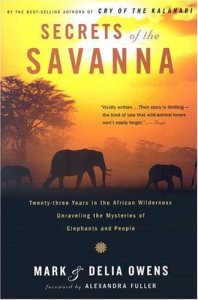
After studying lions in Botswana and writing their better known Cry of the Kalahari, naturalists Mark and Delia Owens left for Zambia.  There the Owenses dedicated themselves to further animal research, mostly into the lives of a dwindling elephant population.  The 2006 memoir Secrets of the Savanna recounts their work and the close shaves they had there.

Poaching leads to fewer elephants, a larger number of orphans, and a dissolution of typical elephant society.  The authors document how the absence of adult females and matriarchs results in earlier pregnancies for orphaned females.  They tell us the story of the orphaned Gift, who becomes a mother too early and whose daughter suffers from her inexperience.

The Owenses also tell stories of their youth as they correspond to elements of the animal kingdom.  For example, Mark relates his father’s death and his own wanderings outside the U.S. to solitary males in other species like lions and elephants.  Delia tells a story of fun and safety in numbers as a teenage female and relates that to life in the elephant herd.  Their share sweet passages about their respective upbringings in Ohio and Georgia.

But like all social mammals, the couple realizes that it’s time to migrate home.  As they plan to leave Zambia, corrupt officials make plans to swoop in and take over their research station.  The research project has created jobs and given locals alternatives to poaching for ivory.  The corrupt officials want to end the research program so the locals will have no alternative but to poach again on their behalf.  It’s a frightening prospect, but the book ends on an optimistic note as one of the local program supporters is able to restore aspects of the project.

Secrets of the Savanna is a well-written book with charming scenes and prose.  While the subject matter of the threatened elephants is gut-wrenching, the Owenses plant enough seeds of hope for a rebound in the population.

Recommended.

Book review: how tech enables smart cities

Standard
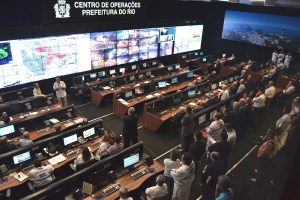
Rio de Janiero's control room

Rio de Janiero’s control room

Anthony Townsend has blended the history of city planning and high-tech innovation and what it means for the future in Smart Cities:  Big Data, Civic Hackers, and the Quest for a New Utopia (2013).

A “smart city” is a city that taps into the power of the internet of things, mobile devices, and big data to improve public services, provide officials with better information, and to realize cost savings.  An example is deploying internet connected sensors to monitor leaks in city water infrastructure and ping officials for repairs.

A challenge to widespread knowledge and adoption of the smart city concept is the amount of salesmanship lurking behind it.  Much of what is written about smart cities originates from press releases by big companies like IBM and Cisco.  They are selling major systems like a control room for Rio de Janeiro to monitor its neighborhoods like NASA would monitor a space launch.

Townsend describes these high-profile smart city examples but also puts them in historical context.  Townsend is generally supportive of smart city innovations, but he is balanced.  He points out flaws, bugs, and risks in certain solutions.  He also explains smaller elements of smart city planning that are more practical for adoption.  Townsend’s context and balance make Smart Cities a valuable resource to cut through the clutter of big businesses’ marketing materials.

Chapter 1 tells a pleasant story in London in 1851 about building the Crystal Palace, an early microcosm of a smart city solution.  The Crystal Palace had precise climate controls through ventilation based on readings from 14 thermostats.  It’s an early model that also serves as a future vision:  an ecosystem where tiny devices trigger appropriate system-wide responses to improve urban living.

Chapter 5, “Tinkering Toward Utopia,” tracks the recent history of app development that has helped connect city dwellers and visitors.  Apps such as Foursquare and Meetup have demonstrated how social apps can thrive when they are tied to specific places like cities.

Chapter 9, “Buggy, Brittle, and Bugged” does a good (and ominous) job of highlighting the risks of large systems that are heavily dependent on technology that is prone to bugs, breaches, and interruptions.

Some of the other chapters aren’t as focused.  Specific topics overlap multiple chapters and previous themes are repeated seemingly at random.  The book would have benefited from better organized chapters with straightforward titles.

Still, there a lots of good nuggets and pearls of wisdom scattered throughout the book.  This book can help inspire innovative thinking among city leaders.  It is probably the best book about “smart cities” on the market.  Recommended for community leaders, civic hackers, government technology professionals, and city planners.

Review: BitCon makes the case against bitcoin

Standard

If you’ve ever been at a meeting or cocktail party where bitcoin comes up in the conversation, BitCon is required reading.  After reading Jeffrey Robinson’s book, you’ll be able to join the conversation with an actual understanding of bitcoins, warts and all, rather than relying solely on vapid news articles and tweets.

The book is extremely critical of bitcoin.  But even bitcoin fans owe it to themselves to read the book.  Robinson has done his homework, and can’t be written off as somebody who doesn’t understand bitcoin.  BitCon explains the fundamentals of bitcoin with easily understood terms and comparisons.  In one passage, Robinson sums up how transactions are verified by bitcoin miners:

What the miners do is put each individually identifiable transaction into an unalterable “block”—more computer code—which is then attached to all the other blocks that have come before it, to form a “blockchain.”  That’s a public ledger where every transaction is visible and set in stone.

BitCon builds on these descriptions by explaining what bitcoin is and what it isn’t.  In terms of the classic definition of money, bitcoin doesn’t meet the criteria of being a medium of exchange or a store of value.  Bitcoin is not a reliable store of value because its exchange rates are extremely volatile.  Would you feel confident taking out a mortgage in bitcoin?

It is not a medium of exchange because it is rarely used to buy goods and services (except in the dark web for underground purchases).  Most of the bitcoins in “circulation” aren’t circulated much.  They are held, hoarded, traded, and speculated by individuals hoping that the volatility will swing in their favor.  When bitcoins are used for dollar-denominated purchases, fees are added coming and going.

High-profile stories about merchants such as car dealers or universities accepting bitcoin are exaggerated and misleading.  Typically, those purchases are cases of a consumer with bitcoin who pay an intermediary bitcoin processor to convert the bitcoins to dollars to pay the merchant.  The headlines leave out the bitcoin converters were involved.

Robinson is a delightful curmudgeon.  There are several laugh-out-loud lines, which is rare for a nonfiction book about technology and money.  BitCon compares bitcoin supporters to a religious cult (and provides several quotes from articles and social media that justify the comparison), referring to them as “The Faithful.”  Vocal bitcoin fans on social media are the “Noise Machine.”  Whenever news or a comment by a high-profile entrepreneur could be interpreted as favorable to bitcoin, the Noise Machine circulates the story far and wide without context or nuance.  When somebody speaks unfavorably about bitcoin, the Noise Machine excoriates them as fools.

Although BitCon takes no prisoners against what Robinson calls “the pretend currency,” he suggests that the enduring and useful aspect of Bitcoin technology will be the blockchain.  A decentralized public ledger will have staying power in recordkeeping separate from currency.  However, BitCon doesn’t spend too much time justifying this assertion.  Many experts are quoted touting blockchain, but the practical advantages of the protocol aren’t fleshed out.  That’s the only weakness in an otherwise enjoyable and informative read.

Book review: cold case heats up in Atlanta

Standard

In Out of the Blues by Trudy Nan Boyce, an experienced police officer (but homicide newbie) nicknamed Salt must reopen an investigation into the suspicious death of a blues musician.  Fortunately for Salt, she is a bigtime blues fan and already knows the major players and venues in the Atlanta blues scene.  She’s also smart and has a knack for finessing the truth out of suspects and witnesses.

Unfortunately, the homicide unit assigns no partner to Salt.  She’s on her own even though it’s her first case.  This is dangerous because the case involves a criminal, drug-dealing, pimping syndicate.  The investigation also involves links to powerful men in Atlanta, including the pastor of a big church and a fellow police officer who is an unofficial gatekeeper for cops working part-time jobs for extra money.  Salt is strong, but she is also vulnerable and has to work diligently and carefully to overcome these obstacles.

Salt is also the only woman on her shift.  This causes some awkwardness and necessitates some heroics to prove herself.  But the gender roles in the book are handled with a fairly light touch—not nearly as heavy-handed as Karin Slaughter’s Cop Town, which focused on the stacked deck against women and resistance to social change in the Atlanta police department 40 years earlier.  Out of the Blues is much less focused on cultural commentary than Cop Town.  Those looking for a more straightforward police procedural in Atlanta without the social analysis will prefer this book.

One weakness of Out of the Blues is the dialogue.  The characters use long words, speak in long sentences, and have very long conversations without major payoffs.  Nevertheless, Salt is engaging and the story is strong enough to carry the reader’s interest to the tidy ending.

Recommended.

Book review: Invasive Species gets under your skin

Standard

Invasive Species, an ecological thriller by Joe Wallace, crawls under your skin from the outset.  A large and seemingly intelligent wasp in Senegal bores into hominid hosts like a tumbu fly.  Getting stung is almost always fatal to humans.  The wasps are nicknamed majizi, meaning thieves, by the locals.  What exactly the majizi are stealing from their hosts, other than their lives, is unclear at first.

Trey Gilliard, a globetrotting biologist, scurries across borders from Africa to the U.S. to Central America and back in an effort to collect specimens and prove the gravity of the threat to a skeptical American government.  At his side are Sheila, a medical doctor and daughter of one of the first American victims of the majizi, and Jack, a loudmouthed New York wasp expert.

The first half of Invasive Species is marvelous.  The majizi are ominous.  Trey, Sheila, Jack, and a curiously insightful Senegalese woman named Mariama are sympathetic because they are alone in attempting to sound the alarm bell.  Like a Crichton novel, the biological explanations and descriptions of the threatening species are convincing without being overly technical.  The well-crafted prose is enjoyable.

About half of the way through, the book shifts toward political themes.  Mariama is implausibly “disappeared” to a Caribbean island by the U.S. government, apparently because her knowledge is a threat to officials who are trying to minimize publicity about the wasps.  Scattered wasp attacks in the U.S. become the subject of debates during a presidential campaign.  At this point, Invasive Species begins resembling the 1980s alien invasion book, Footfall, where government officials become embroiled in reacting to an aggressive, otherworldly species threatening to annihilate humanity.

Like the herd mentality of the Fithp elephants in Footfall, the majizi exhibit a collective awareness.  The human team learn the hard way that the wasps’ hive mind makes them an even more dangerous foe.  Star Trek fans will detect parallels between the majizi and the Borg, the aggressive species of invaders that absorb their victims in order to expand the collective.

Although the book is on firmer footing when dealing with scientific rather than political topics, the novel is well worth a read.  Fans of Crichton or the pulp horror animal attack books of the 1980s will love this more contemporary, globalized heir to the genre.  Students of disease outbreaks and readers of books like the Hot Zone will appreciate the disturbing trends of international pandemics that Wallace highlights.

Book review: Island 731 delivers non-stop chills

Standard

A 2014 bio-thriller

In Jeremy Robinson’s thriller Island 731, an ecological expedition in the Pacific runs aground on an unknown island.  A crewmate flees and Hawkins, a hero who earlier survived a grizzly bear attack, sets out to find him.  Hawkins and his love interest, the risk-taking Joliet, plunge inland despite initial signs of danger.

Why their geeky but likable crewmate Kam would have run away makes no sense at first.  Hawkins and Joliet speculate that Kam went into hiding after killing another crewmate:

“That’s my best theory.”

Joliet sagged.  “I came up with the same thing.  Do you really think Kam would run?  If it was an accident—”

The search is complicated as Hawkins and Joliet quickly learn that the island is teeming with dangerous lifeforms that are blends of more than one species.  The discovery of an island with previously undiscovered creatures makes this thriller reminiscent of The Land That Time Forgot.  And like Edgar Rice Burrough’s classic, the threats to the protagonists aren’t only from the island’s beasts, but from frictions within the marooned crew.

An island full of chimeras is exciting, foreboding, and mysterious.  It creates a great, dark atmosphere.  That being said, some of the chimeras have so many progenitors that they are difficult to visualize.  For example, one chimera has a face with features from a bat, goat, tiger, and crocodile.  Tough to picture.

The search leads the main characters into more danger and closer to the truth of the island.  Without giving any spoilers, Robinson’s work shows a broad familiarity with biology, history, and conspiracy theories.  Island 731 delivers plausibly on these themes.  There is some background and technical information that must be conveyed for the story to make sense, but Robinson handles those passages economically without retarding the action.

The characters are engaging.  Larger-than-life villains and bald faced evil make for an ambitious book, but Robinson pulls it together.  Hawkins’s jovial sidekick Bray is fun, and the romance between Hawkins and Joliett is well done.

Parts of the book are gruesome:  one character is crucified hanging from his own entrails.  “Patients” are dissected alive.  If you didn’t like the bloody, gross-out scenes of the movie “Saw,” this may not be the right book for you.

Some thrillers have great beginnings and the action falls apart toward the end or doesn’t pay off.  That’s not the case with Island 731.  The action builds throughout and the stakes get higher toward the end.  Robinson has a good sense for plot, pace, tension, and momentum.  The characters are always on the move and run into one obstacle after another.

For readers who are drawn to thrillers because they enjoy non-stop thrills and chills, look no further.  If you’ve got a dark streak, you’ll want to bring this apocalyptic island adventure on your next cruise.

Book Review: Breaking Creed breaks into a gallop

Standard

Breaking Creed, a suspense novel by Alex Kava, opens with a girl swallowing condoms filled with cocaine.  Amanda is a drug mule seduced by an abusive Latin American kingpin.  Ryder Creed, who was a Marine and is now a dog handler, detects Amanda at Hartsfield-Jackson International Airport in Atlanta with the help of Grace, a Jack Russell Terrier with a nose for mischief.

Rather than turning Amanda over to the authorities at Hartsfield or taking her the hospital, Creed drives her to his home—in Florida!  This was an extremely peculiar and implausible decision that distracted me for several chapters.  The shock of a grown man taking an underage girl across state lines alone gradually wore off as we learned that Creed operates a halfway house that can help Amanda.

The Creed storyline is intercut with scenes of Special Agent Maggie O’Dell, who is assigned with a homicide case of a “floater” pulled out of the Potomac.  The victim was killed and tortured while strapped to a mound of fire ants.  O’Dell travels to Alabama to investigate where the torture took place.  The investigation and the investigators themselves are targeted by an unknown assassin who uses lethal animals or insects to strike his victims.  It’s a chilling approach.

Creed helps out on the Alabama case, too.  Grace, his Jack Russell Terrier, isn’t just a drug dog or a rescue dog or cadaver dog, she’s an all-purpose crime-stopping dog.  Whenever Grace finds what Creed seeks, he rewards her with her favorite thing—a pink elephant chew toy.  I’m not sure how plausible it is that Grace has so many talents, but she is a fun dog character.  Grace isn’t just a prop or an object of affection in the book—she is a dog that actually affects the plot in several ways throughout the book.

The assassin’s methodology, dog scenes, and galloping pace of the plot make Breaking Creed a fun, quick read.

Less enjoyably, there are many coincidences and convenient turns of events that cause Creed and O’Dell to work together throughout the book.  Their separate investigations merge more than once.  The way Creed and O’Dell get excited to see each other but try to play it cool reminds me of romance novel tropes.  A lot of emotions are attributed to Creed and other male characters in an unconvincing way like romance novelists sometimes do.  There is definitely more action here than in a Nora Roberts book, but overall I would categorize Breaking Creed as a romantic suspense, not as a thriller or mystery as it has been classified by Goodreads and Amazon.

Another word of warning:  although the back cover book blurb makes it sound like the book is set in Atlanta, it isn’t.  Only a couple pages are.

Breaking Creed is the first of the “Creed” series by Alex Kava.

Book review: my verdict on The Verdict

Standard

In Nick Stone’s The Verdict, a law clerk in Britain must defend an old enemy on charges of murdering a blonde in his hotel suite.  The clerk, Terry, decides to defend the suspect, VJ, as best as he can despite being burned by him 20 years earlier.  The defense team’s investigation takes Terry on a wild ride through the streets of London, dodging bullets and working with a colorful and sleazy investigator.

This is a well told story that keeps you guessing.  Is VJ’s story true or did he kill the blonde?  The investigation points in one direction, but will trial go the same way?  What were the reasons for Terry and VJ’s falling out and will they reconcile?  When will Terry’s law firm fire him?  The answers are expertly woven together throughout the course of the book.

In addition to the suspense, there are two other compelling aspects of the book.  First, the trial itself is engrossing.  Although we are familiar with the details of the investigation by the time the trial begins, Stone writes the lawyers’ opening statements, questions to the witnesses, and closing arguments in a way that keeps surprising us.

Secondly, Terry’s character is very well developed.  The book is told from his point of view.  Terry is very frank and personal with the readers about his own failings and past.  We learn more about him through the novel than his wife knows about him.  Because of that, you will feel closer to him than you may feel toward most protagonists in contemporary thrillers.

On the downside, the book is long.  It took me three times longer to read this compared to other thrillers I’ve read lately.  There were a few implausible scenes in Part III of the novel that didn’t work for me.  The trial does not begin until three-quarters of the way through the novel, so calling this a “courtroom drama” is misleading.  There is also a confusing B-story that related to the main story but didn’t add much to it.

Overall, I thoroughly enjoyed the book and would recommend it Grisham fans, speed readers, and Anglophiles.