Book review: The Looters is an overlooked gem

Standard

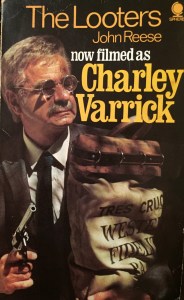
Bank heist book cover

What an underappreciated storyteller was John Reese.  In some ways an heir to James Cain and Dashiell Hammet, Reese was able to create visceral plots infused with palpable greed, criminality, and menace in sunbaked California landscapes.

The Looters (1968) was billed on some book covers as “The exciting and violent story of a bank robbery.”  Indeed, the book includes such a story, but that doesn’t do it justice and the story doesn’t end there.  The Tres Cruces National Bank isn’t exactly as clean and pure as the wind-driven snow.  Investigators initially suspect that the robbery was an inside job orchestrated by somebody within the shadowy, mostly Italian owned parent entity that controls the bank.

Everybody loves money, but few people like numbers or financial complexity.  Even fewer can tolerate reading about the subject.  Reese is one of those rare authors who is able to convey a complicated financial caper to thrill his readers rather than crossing their eyes.  He did it with Two Thieves and a Puma and again with this book.  His quirky characters and their motivations are what carry the readers through the turning points in his plots.  Reese also usually takes time to explain what the financial interests of the different players are so readers don’t get lost.

In The Looters, Reese also shows that he is the master of creating characters who are complete jerks.  Take J. J. Schirmer, a bank executive who is not only prejudiced against Italians (constantly referring to his business partners as greasy Sicilian bastards or “Sicilian perverts”), he’s vile to work for.  In one of several scenes like it, Schirmer needlessly berates his driver, Eddie, at 8 a.m.:

Schirmer put down the phone and shouted for Eddie.  The chauffeur had slept in the lounge outside, and was still not dressed. ‘I been waiting to hear you was awake, Mist’ Schirmer,’ he said.

‘All right, you heard. Go get me a pot of coffee.’

‘I cain’t go like this, seh. I phone for it and have it here before—’

‘God damn it, I could have phoned for it. I want to use the phone!’

‘I go fetch it.’

‘Never mind! I’m going to take a shower. Call for some coffee and then put in a call for Sybil at her place.’

The Looters is filled with deliciously nasty dialogue like that, and characters like Schirmer who show their cruelty, caprice, and superiority complexes at every turn.  Molly, a hired gun working for the Italians, is a world-class sadist and creep tasked with hunting down the bank robber before law enforcement gets him.  They are all harsh to take, but fun to read about.

The downside to the host of characters is that there isn’t a single antagonist or a single hero.  There are good qualities and bad qualities on all three sides of the character triangle:  the bank robbers, the bank owners, and law enforcement.  The lack of a single main character gives the book a different style and impact than the movie, which focused on Varrick (and made him more genial than the hard and ruthless robber in the book).

Reviews of this book have noted that the ending is different from the movie.  That is true, and in several ways, the film’s ending is superior to the book.  The memorable biplane chase from the movie is nowhere to be found in the book.  Whoever came up with that idea for the movie deserves credit for the exciting addition, which was quite sensible considering that Charley Varrick and his partner were crop dusters in the book.

The book’s ending was jarring.  The scene where Molly finds Charley occurs too suddenly, with very little build-up.  It would have been improved if Molly had to chase a few more leads prior to finding Charley, and if their physical confrontation had been more drawn out.  Because of that and the murkiness about the main character, I bump this book down from five stars to four.

That being said, this is still a sweat-inducing pistol of book ideal for a late-summer read.

Book review: Where Angels Prey is informative read

Standard

Indian financial thriller

In Ramesh S. Arunachalam’s thriller, Where Angels Prey, Bob, a Western journalist, arrives in India to write an article about Prasad Kamineni, a micro-finance executive.  He teams up with Chandresh, an eager local journalist aware of the darker side of micro-finance in India.  Veena Mehra, district magistrate of Ranga Reddy (in Andhra Pradesh), is also conducting an investigation into Prasad’s business.

Many of the micro-finance debt collectors, including those employed by antagonist Prasad’s SAMMAAN bank, are conducting loan shark style tactics.  They humiliate and threaten borrowers to the point where the debtors, such as a sympathetic widow named Mylaram, commit suicide.  Another case unfolds during the action of the book, where Rammaiyya, who was going to serve as an informant against SAMAAN, is mysteriously killed.  These cases are a continuation of the ruthless tactics used by money lenders that Maoist insurgents fought against in earlier decades.

Micro-finance is a much celebrated concept in the West, and the leaders of the micro-finance movement such as Muhammad Yunus are lionized as heroes ushering in a new era of equity and opportunity in the developing world.  This informative book sheds much needed light on a concept that is not so rosy in reality.

 As narrative fiction, Where Angels Prey could have been improved.  The syntax takes some getting used to for an American reader.  While the author is a skilled writer, there are grammatical oddities and formatting issues that could have been reduced with a more professional editing job.  The present tense verb choice throughout the narrative is awkward.  A constant parade of characters gets confusing, especially since many of them are not substantially developed.  Just as soon as you learn about a new character and start to get a feeling for him or her, they disappear.  It is more of an “ensemble cast” than a book with a single main character. Either Bob or Chandresh is the hero of this financial thriller, but the story probably would have been strengthened by picking one of them to develop further.  Veena’s investigation was duplicative of the journalistic one.  Also, there is a lot of “telling not showing”: abusive tactics are described in general, rather than experiencing them all through eye-witness accounts in real time.

On the plus side, the novel was suspenseful.  One wants to learn how it all turns out for Prasad, who is a compelling villain who is also sympathetic in several ways.

People who are interested in predatory lending, poverty, international development, and socioeconomics should check this novel out.

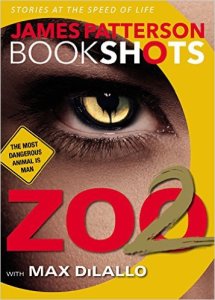
Book review: Zoo 2 is fast and fierce

Standard

2016 thriller novella cover

Clever scenes, exotic locations, and, for an animals-attack thriller, nothing too over the top.

James Patterson’s Zoo 2, which Patterson and his marketers call a “bookshot” is actually a novella and a sequel to the longer 2012 novel, Zoo.  It picks up where the original left off, with intrepid, un-credentialed scientist Jackson Oz and his family in Greenland taking refuge from the resurgence in animal attacks ongoing in the U.S. and other temperate regions.

The President summons Jackson back into action.  Jackson decides to leave his wife Chloe at her parents’ home in France while he goes to research the possible spread of aggressive behavior from animals into isolated human cases.  Some readers don’t seem to like the concept that “humans are evolving” in this sequel.  There is a ‘feral human’ story line, and it worked for me!  The dangerous human theme doesn’t go overboard into full zombie apocalypse mode, but it’s a serious enough threat that it changes the dynamics from the original Zoo book or the “Zoo” TV series. If this sequel had only been another series of animal attacks, it probably would have unsatisfying, boring, or both. The feral human angle gave it an extra dose of horror.

Zoo 2 is well-written—a step-up in professionalism compared to some other monster novels out there.  (This may be thanks to Patterson’s co-writer, Max DiLallo.) The shorter novella platform was just right for the subject matter and for me. A quicker read than the original Zoo with fewer hokey set-ups.

The only thing I didn’t like about the book is something that happens early on at Chloe’s home in Paris.  Let’s just say that two people end up dead, when killing off one character would have worked just as well.  Especially considering that Chloe didn’t seem to be that upset—you think she’d have been devastated, possibly for the rest of the book.

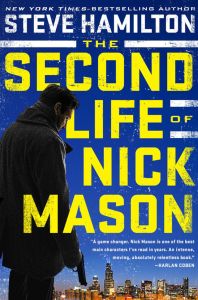
Book review: Two Stars for Second Life

Standard

second-life-of-nick-mason-steve-hamilton-review

Clever idea that got off track.

A Chicago mob boss in prison arranges for the release of a fellow inmate 5 years into a 25-year sentence to become his assassin on the outside.  Once free, Nick Mason, a former car thief, finds out that being released to kill people is worse than being in prison, even though his targets are mostly dirty cops.

It is an intriguing concept.  Quintero, Nick’s handler on the outside, tells Nick early on that freedom is different from mobility—don’t get the two confused.  Great line.  And it sums up the plot of the novel.  Nick is mobile because he left prison, and can basically go where he wants, but he’s on call 24/7 to carry out a hit.  The mob boss, Cole, controls Nick, and threatens his family if he tries to wiggle out of the 20-year deal.

However, for a man who had only stolen cars to become a cop killer almost overnight is tough to swallow.  He’s able to run circles around all of his targets and almost all of the other characters in the book.  Maybe if Nick made more mistakes, or had a somewhat darker past, it would be more plausible.

Just as easily as Nick becomes a master assassin, he proves himself to be quite the lady’s man, quickly meeting a woman who wants to know “what five years feels like.” Eh hmm.  Most of the female characters seem interested in either getting in bed with Nick, or with scolding him for ruining their lives in the past.  There’s not much middle ground.

While Nick is running around killing people, a homicide detective named Sandoval is on the trail of the corrupt cops.  The scenes involving Sandoval and the SIS, an elite police unit, are a bit complicated and tricky to follow.

I listened to the audiobook which was a mistake.  The narrator’s tone was extremely bitter in the first 20 percent of the book, which makes some sense because it is set in prison.  However, some lines that I would have read as factual commentary are dripping with venom in the audiobook.  In other words, the tone was overkill.  The mob boss’s voice sounds like a cross between Lucious Lyon from “Empire” and Barack Obama, which was distracting.  Each female character sounded identical, flippant, and naggy.  The narrator has great vocal talents but overall this narration didn’t work for me.

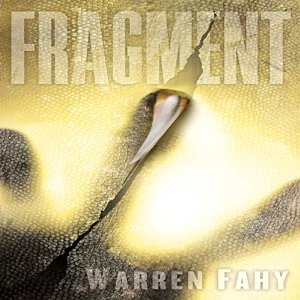
Book review: Fragment delivers ecological fun

Standard

Fragment

A remote, tiny island in the Pacific teems with unique, aggressive species.  But they aren’t dinosaurs from The Land that Time Forgot; they are distant relatives of mantis shrimp that evolved on a separate track from the rest of the earth in Fragment, a 2009 eco-thriller that is more plausible than a living dinosaur book.  The new species are first discovered by the crew of a reality show called “SeaLife.”  The U.S. Navy takes over because of the risk that the dangerous species could leave the island and destroy continental ecosystems, or hostile regimes could exploit the island to develop biological weapons.

Some reviewers have been critical of the “pseudo-science” in Fragment.  But ask yourself, is the science in Mary Shelley’s Frankenstein believable?  How about Arthur Conan Doyle’s Lost World?  Or Michael Crichton’s Congo?  Those books all stretch science as it was understood in the era of the authors to create a compelling story.

Fragment isn’t in the same league as those classic tales of scientific exploration, but it is an exciting, contemporary story.  The setting of the book, “Henders Island,” is an imaginative place.  The best element of the book is the characters’ struggle to survive in the ominous setting.  Thatcher Redmond, the villain of the book, is fun to hate, and his imperious voice was the highlight Robin Atkin Downes’s narration in the audiobook version.

The U.S. government has several possible ways to deal with the threat of the aggressive species on Henders Island.  Without spoiling the ending, I will just say that I was not a fan of the solution.  That is my number one complaint about the book, but it made for good drama.

Book review: Zero Alternative skewers “too-big-to-fail”

Standard

Pageflex Persona [document: PRS0000035_00017]

From the recession of 2008 was born a litter of woes.  Mortgage defaults.  Foreclosures.  Cram downs.  Lay-offs.  Furlough days.  Stagnant wages.

Was the recession caused by exotic financial instruments like mortgage-backed securities?  Was it the result of excessive pressure from the federal government on banks to issue home loans to borrowers who couldn’t pay the bills?  Or just the boom and bust of the business cycle?

That’s not the way that Scott “Yours” Walker (surely, an unintentional homonym with no relation to the governor of Wisconsin), the main character in Luca Pesaro’s financial techno-thriller Zero Alternative (2014), sees it.  Walker, an investment banker with a skeptical mind, inhabits a darker world, where friends and enemies alike work for larger, shadowy entities pulling strings behind the scenes.

The story begins with a banner performance by Walker, making millions in one day of trading when everybody in London but him predicted the worst.  It’s all downhill for Walker from there.  Walker’s friend D.M., who is just finishing the creation of a powerful predictive analytics software that can anticipate ups and downs in the market, is murdered.  The killer attempts to frame Walker, who has the next most knowledge of the software.

Walker goes on the lam with a hired gun on his tail.  Hired by a rival investment bank, perhaps.  The sexy woman at his side, Layla, was working for the hired gun, after she quit working for a foreign spy agency.  While on the run with her, Walker must trust her when she says she’s working for herself now.  They travel from London to France to Switzerland to Italy to the U.S., facing close shaves at every turn and doubting but seducing each other along the way.

The computer program is valuable enough to kill for.  While Walker isn’t above using the program to make money for himself or his allies while in hiding, he mainly wants to use the application to bring down an odious investment bank.  This is his act of rebellion against the too-big-to-fail financial system which is rigged to make money for itself regardless market direction or morality.  The adventure of Zero Alternative is in Walker’s personal, international life-and-death cage match against overwhelming forces of greed.  Whether Walker’s his pursuers will steal the computer program, whether he will be able to use the program against the financial system, and the question of Layla’s reliability, are compelling elements.

There is stock market terminology and information technology jargon in the book, but it is not excessive.  The movement of Walker and Layla across the borders of Europe into Italy are plausible for a man of Walker’s resources.  Where things get a little shaky are the oracle-like foresight of the computer program.  It might have been more plausible if the application occasionally predicted the wrong outcome, required input of more data in order to make a prediction, or if it had a lot of bugs to be worked out.  Also, the politics—the allegation that the recession is mainly the result of corporate greed—is not for all tastes.  But the excitement of the international chase and the tense romance make up for that.  Recommended.

Book review: Invasive Species gets under your skin

Standard

Invasive Species, an ecological thriller by Joe Wallace, crawls under your skin from the outset.  A large and seemingly intelligent wasp in Senegal bores into hominid hosts like a tumbu fly.  Getting stung is almost always fatal to humans.  The wasps are nicknamed majizi, meaning thieves, by the locals.  What exactly the majizi are stealing from their hosts, other than their lives, is unclear at first.

Trey Gilliard, a globetrotting biologist, scurries across borders from Africa to the U.S. to Central America and back in an effort to collect specimens and prove the gravity of the threat to a skeptical American government.  At his side are Sheila, a medical doctor and daughter of one of the first American victims of the majizi, and Jack, a loudmouthed New York wasp expert.

The first half of Invasive Species is marvelous.  The majizi are ominous.  Trey, Sheila, Jack, and a curiously insightful Senegalese woman named Mariama are sympathetic because they are alone in attempting to sound the alarm bell.  Like a Crichton novel, the biological explanations and descriptions of the threatening species are convincing without being overly technical.  The well-crafted prose is enjoyable.

About half of the way through, the book shifts toward political themes.  Mariama is implausibly “disappeared” to a Caribbean island by the U.S. government, apparently because her knowledge is a threat to officials who are trying to minimize publicity about the wasps.  Scattered wasp attacks in the U.S. become the subject of debates during a presidential campaign.  At this point, Invasive Species begins resembling the 1980s alien invasion book, Footfall, where government officials become embroiled in reacting to an aggressive, otherworldly species threatening to annihilate humanity.

Like the herd mentality of the Fithp elephants in Footfall, the majizi exhibit a collective awareness.  The human team learn the hard way that the wasps’ hive mind makes them an even more dangerous foe.  Star Trek fans will detect parallels between the majizi and the Borg, the aggressive species of invaders that absorb their victims in order to expand the collective.

Although the book is on firmer footing when dealing with scientific rather than political topics, the novel is well worth a read.  Fans of Crichton or the pulp horror animal attack books of the 1980s will love this more contemporary, globalized heir to the genre.  Students of disease outbreaks and readers of books like the Hot Zone will appreciate the disturbing trends of international pandemics that Wallace highlights.

Book review: Island 731 delivers non-stop chills

Standard

A 2014 bio-thriller

In Jeremy Robinson’s thriller Island 731, an ecological expedition in the Pacific runs aground on an unknown island.  A crewmate flees and Hawkins, a hero who earlier survived a grizzly bear attack, sets out to find him.  Hawkins and his love interest, the risk-taking Joliet, plunge inland despite initial signs of danger.

Why their geeky but likable crewmate Kam would have run away makes no sense at first.  Hawkins and Joliet speculate that Kam went into hiding after killing another crewmate:

“That’s my best theory.”

Joliet sagged.  “I came up with the same thing.  Do you really think Kam would run?  If it was an accident—”

The search is complicated as Hawkins and Joliet quickly learn that the island is teeming with dangerous lifeforms that are blends of more than one species.  The discovery of an island with previously undiscovered creatures makes this thriller reminiscent of The Land That Time Forgot.  And like Edgar Rice Burrough’s classic, the threats to the protagonists aren’t only from the island’s beasts, but from frictions within the marooned crew.

An island full of chimeras is exciting, foreboding, and mysterious.  It creates a great, dark atmosphere.  That being said, some of the chimeras have so many progenitors that they are difficult to visualize.  For example, one chimera has a face with features from a bat, goat, tiger, and crocodile.  Tough to picture.

The search leads the main characters into more danger and closer to the truth of the island.  Without giving any spoilers, Robinson’s work shows a broad familiarity with biology, history, and conspiracy theories.  Island 731 delivers plausibly on these themes.  There is some background and technical information that must be conveyed for the story to make sense, but Robinson handles those passages economically without retarding the action.

The characters are engaging.  Larger-than-life villains and bald faced evil make for an ambitious book, but Robinson pulls it together.  Hawkins’s jovial sidekick Bray is fun, and the romance between Hawkins and Joliett is well done.

Parts of the book are gruesome:  one character is crucified hanging from his own entrails.  “Patients” are dissected alive.  If you didn’t like the bloody, gross-out scenes of the movie “Saw,” this may not be the right book for you.

Some thrillers have great beginnings and the action falls apart toward the end or doesn’t pay off.  That’s not the case with Island 731.  The action builds throughout and the stakes get higher toward the end.  Robinson has a good sense for plot, pace, tension, and momentum.  The characters are always on the move and run into one obstacle after another.

For readers who are drawn to thrillers because they enjoy non-stop thrills and chills, look no further.  If you’ve got a dark streak, you’ll want to bring this apocalyptic island adventure on your next cruise.

Book Review: Breaking Creed breaks into a gallop

Standard

Breaking Creed, a suspense novel by Alex Kava, opens with a girl swallowing condoms filled with cocaine.  Amanda is a drug mule seduced by an abusive Latin American kingpin.  Ryder Creed, who was a Marine and is now a dog handler, detects Amanda at Hartsfield-Jackson International Airport in Atlanta with the help of Grace, a Jack Russell Terrier with a nose for mischief.

Rather than turning Amanda over to the authorities at Hartsfield or taking her the hospital, Creed drives her to his home—in Florida!  This was an extremely peculiar and implausible decision that distracted me for several chapters.  The shock of a grown man taking an underage girl across state lines alone gradually wore off as we learned that Creed operates a halfway house that can help Amanda.

The Creed storyline is intercut with scenes of Special Agent Maggie O’Dell, who is assigned with a homicide case of a “floater” pulled out of the Potomac.  The victim was killed and tortured while strapped to a mound of fire ants.  O’Dell travels to Alabama to investigate where the torture took place.  The investigation and the investigators themselves are targeted by an unknown assassin who uses lethal animals or insects to strike his victims.  It’s a chilling approach.

Creed helps out on the Alabama case, too.  Grace, his Jack Russell Terrier, isn’t just a drug dog or a rescue dog or cadaver dog, she’s an all-purpose crime-stopping dog.  Whenever Grace finds what Creed seeks, he rewards her with her favorite thing—a pink elephant chew toy.  I’m not sure how plausible it is that Grace has so many talents, but she is a fun dog character.  Grace isn’t just a prop or an object of affection in the book—she is a dog that actually affects the plot in several ways throughout the book.

The assassin’s methodology, dog scenes, and galloping pace of the plot make Breaking Creed a fun, quick read.

Less enjoyably, there are many coincidences and convenient turns of events that cause Creed and O’Dell to work together throughout the book.  Their separate investigations merge more than once.  The way Creed and O’Dell get excited to see each other but try to play it cool reminds me of romance novel tropes.  A lot of emotions are attributed to Creed and other male characters in an unconvincing way like romance novelists sometimes do.  There is definitely more action here than in a Nora Roberts book, but overall I would categorize Breaking Creed as a romantic suspense, not as a thriller or mystery as it has been classified by Goodreads and Amazon.

Another word of warning:  although the back cover book blurb makes it sound like the book is set in Atlanta, it isn’t.  Only a couple pages are.

Breaking Creed is the first of the “Creed” series by Alex Kava.

Book review: my verdict on The Verdict

Standard

In Nick Stone’s The Verdict, a law clerk in Britain must defend an old enemy on charges of murdering a blonde in his hotel suite.  The clerk, Terry, decides to defend the suspect, VJ, as best as he can despite being burned by him 20 years earlier.  The defense team’s investigation takes Terry on a wild ride through the streets of London, dodging bullets and working with a colorful and sleazy investigator.

This is a well told story that keeps you guessing.  Is VJ’s story true or did he kill the blonde?  The investigation points in one direction, but will trial go the same way?  What were the reasons for Terry and VJ’s falling out and will they reconcile?  When will Terry’s law firm fire him?  The answers are expertly woven together throughout the course of the book.

In addition to the suspense, there are two other compelling aspects of the book.  First, the trial itself is engrossing.  Although we are familiar with the details of the investigation by the time the trial begins, Stone writes the lawyers’ opening statements, questions to the witnesses, and closing arguments in a way that keeps surprising us.

Secondly, Terry’s character is very well developed.  The book is told from his point of view.  Terry is very frank and personal with the readers about his own failings and past.  We learn more about him through the novel than his wife knows about him.  Because of that, you will feel closer to him than you may feel toward most protagonists in contemporary thrillers.

On the downside, the book is long.  It took me three times longer to read this compared to other thrillers I’ve read lately.  There were a few implausible scenes in Part III of the novel that didn’t work for me.  The trial does not begin until three-quarters of the way through the novel, so calling this a “courtroom drama” is misleading.  There is also a confusing B-story that related to the main story but didn’t add much to it.

Overall, I thoroughly enjoyed the book and would recommend it Grisham fans, speed readers, and Anglophiles.